Stewardship
"Leadership is not ultimately the stewardship of people. It is the stewardship of organizational meaning."
A Different Responsibility
Every enduring system depends upon something being continuously cared for. A garden requires cultivation. A scientific discipline requires careful stewardship of knowledge. A constitution requires interpretation across generations. An ecosystem depends upon relationships remaining healthy despite continuous change. Organizations are no different. They evolve constantly. People join. People leave. Strategies change. Technologies advance. Artificial intelligence continuously generates new knowledge. Nothing remains static. Yet some organizations retain a remarkable sense of continuity. They remain recognizably themselves while continuously adapting. This does not happen accidentally. It requires stewardship.
Beyond Management
For more than a century, management has largely understood leadership through authority. Leaders define direction. Managers allocate resources. Teams execute. Performance is measured. Results are evaluated. This model has built extraordinary organizations, and it remains essential. But it reflects a particular understanding of leadership: direct people, control work, improve execution.
The Correspondence perspective introduces another responsibility: preserve meaning. Management asks, "How do we organize work?" Stewardship asks, "What must remain meaningfully connected while the organization changes?"
The two are complementary. Management enables execution. Stewardship enables continuity. Leadership directs activity. Stewardship preserves meaning. To understand this distinction, it helps to visualize stewardship not as a management function, but as the ongoing responsibility for preserving organizational coherence.
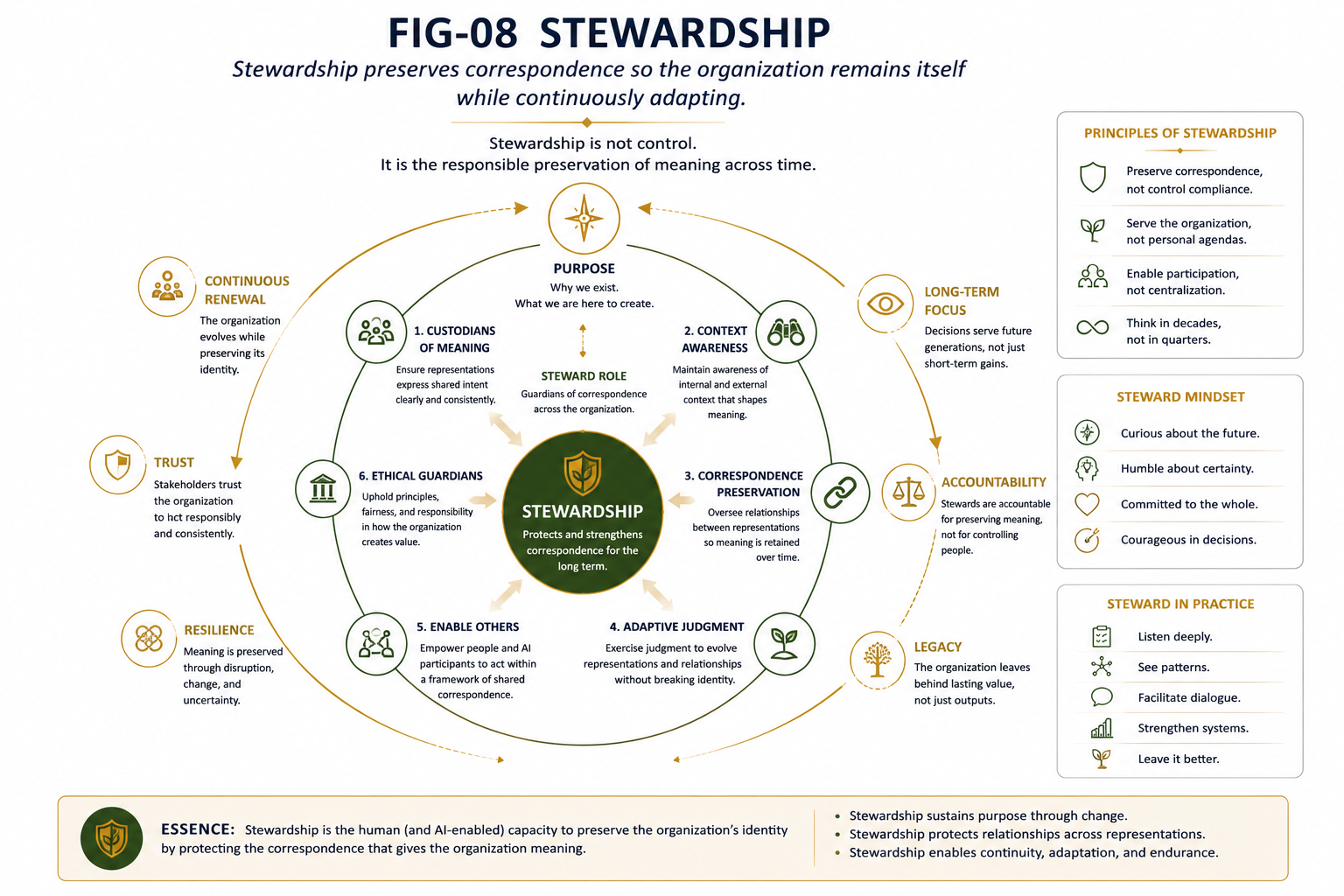
Stewardship. Stewardship is the continuous responsibility for preserving meaningful relationships across the Representation Network. Rather than controlling individual activities, stewardship protects the coherence that enables organizations to learn, adapt, and remain recognizably themselves over time.
What Is Being Stewarded?
Stewardship has traditionally been associated with tangible assets: financial stewardship, environmental stewardship, data stewardship, and technology stewardship. The Correspondence perspective introduces another object of stewardship: organizational meaning. More specifically, stewardship preserves the relationships that connect meaning across time among purpose, strategy, policies, decisions, actions, learning, and memory. These representations continuously evolve. Stewardship ensures they continue evolving together. Leadership therefore becomes less about protecting stability and more about protecting continuity.
Stewardship Is Distributed
Traditional leadership models often concentrate responsibility at the top of the organization. Boards govern. Executives lead. Managers supervise. Employees execute. Reality is increasingly different. Every meaningful decision influences organizational correspondence: a product manager choosing priorities, an engineer redesigning a service, a customer success specialist documenting recurring problems, a software architect defining interfaces, or an AI agent generating implementation recommendations. Each contributes to the Representation Network. Each either strengthens or weakens correspondence.
Stewardship therefore cannot belong exclusively to executives. It becomes a distributed organizational capability. Everyone participates. The question is no longer "Who leads?" It becomes "Who preserves meaning?" Increasingly, the answer is everyone who contributes to the organization.
AI Changes Stewardship
Artificial intelligence transforms stewardship in two important ways. First, AI becomes a participant: it generates representations, identifies relationships, suggests decisions, and creates new organizational knowledge. Second, AI becomes an amplifier: it reveals inconsistencies humans overlook, detects fragmentation, reconnects historical context, and supports organizational memory. These capabilities strengthen stewardship. They do not replace it. Artificial intelligence cannot determine organizational purpose, define organizational values, or decide what should remain meaningful. Those remain fundamentally human and organizational responsibilities. Stewardship therefore becomes a partnership in which humans provide purpose, artificial intelligence expands visibility, and together they preserve correspondence.
Stewardship Is Continuous
Organizations often approach governance as a periodic activity: quarterly reviews, annual strategy updates, transformation programs, and audit cycles. Stewardship works differently. It is continuous. Every conversation influences understanding. Every representation reshapes context. Every decision strengthens or weakens relationships. Every lesson either reconnects the organization or quietly disappears. Stewardship is therefore not a committee, a project, or an annual event. It is an everyday organizational practice. The organization is always becoming. Stewardship ensures it never loses itself while doing so.
Case Lens: Stewardship in a Learning System
Case classification: illustrative example.
Toyota's public description of the Toyota Production System emphasizes ideas such as making problems visible, stopping to address abnormalities, and pursuing continuous improvement. This book does not treat Toyota as a direct example of the Correspondence Organization. The point is more limited: durable operating systems often depend on practices that preserve relationships among observation, authority, action, and learning. That is what stewardship adds to management. It is not only the assignment of responsibility. It is the care of the connections that allow a problem observed in one place to become learning for the organization as a whole.
Measuring Leadership Differently
Leadership has traditionally been evaluated through outcomes: revenue, growth, efficiency, innovation, and shareholder value. These measures remain important. The Correspondence perspective introduces another.
Did leadership preserve the organization's ability to think coherently while continuously changing?
Organizations with strong stewardship often appear remarkably resilient, not because change is absent, but because coherence survives change. People understand why priorities evolve. Learning accumulates. Artificial intelligence remains trusted. Purpose remains visible. These organizations rarely appear rigid. They simply remain recognizably themselves.
Stewardship Creates the Conditions for Wisdom
Stewardship does not directly produce Organizational Wisdom. It creates the conditions from which wisdom emerges. By preserving correspondence, stewardship protects Cognitive Integrity. By protecting Cognitive Integrity, organizations accumulate learning instead of repeatedly losing it. Judgment improves. Experience compounds. Purpose remains visible across generations. Over time, the organization develops something that cannot be reduced to any individual leader, technology, or process: not the wisdom of individuals, but the wisdom of the organization itself. The next chapter explores how that wisdom emerges—and why it may become the defining capability of AI-native organizations.