The Correspondence Organization
"An organization is not defined by its structure. It is defined by its ability to preserve meaning while continuously changing."
Seeing the Whole
Throughout this book we have examined organizations from many different perspectives. We began with a meeting that should not have failed. We discovered an invisible organization beneath the visible one. We explored organizational memory. We examined organizational drift. We introduced representations. We saw how representations form living networks. We defined Correspondence. We discovered Cognitive Integrity. We redefined leadership as stewardship. We concluded that Organizational Wisdom emerges over time. None of these ideas exists independently. Each explains only part of a larger reality. Together they describe something fundamentally different: not another management framework, but a different way of understanding organizations. The Correspondence Organization.
Beyond the Organization Chart
For more than a century, organizations have largely been understood through what can be seen: departments, functions, processes, reporting relationships, governance, and technology. These remain essential because they coordinate work, allocate responsibility, support accountability, and enable execution. Yet they cannot fully explain why organizations remain coherent while continuously changing. Two organizations may possess remarkably similar structures. One steadily becomes stronger. The other slowly fragments. The explanation cannot be found in the organizational chart. It must be found somewhere deeper. The Correspondence Organization begins with that observation. To understand the whole model, it helps to see how the concepts introduced throughout this book relate to one another.
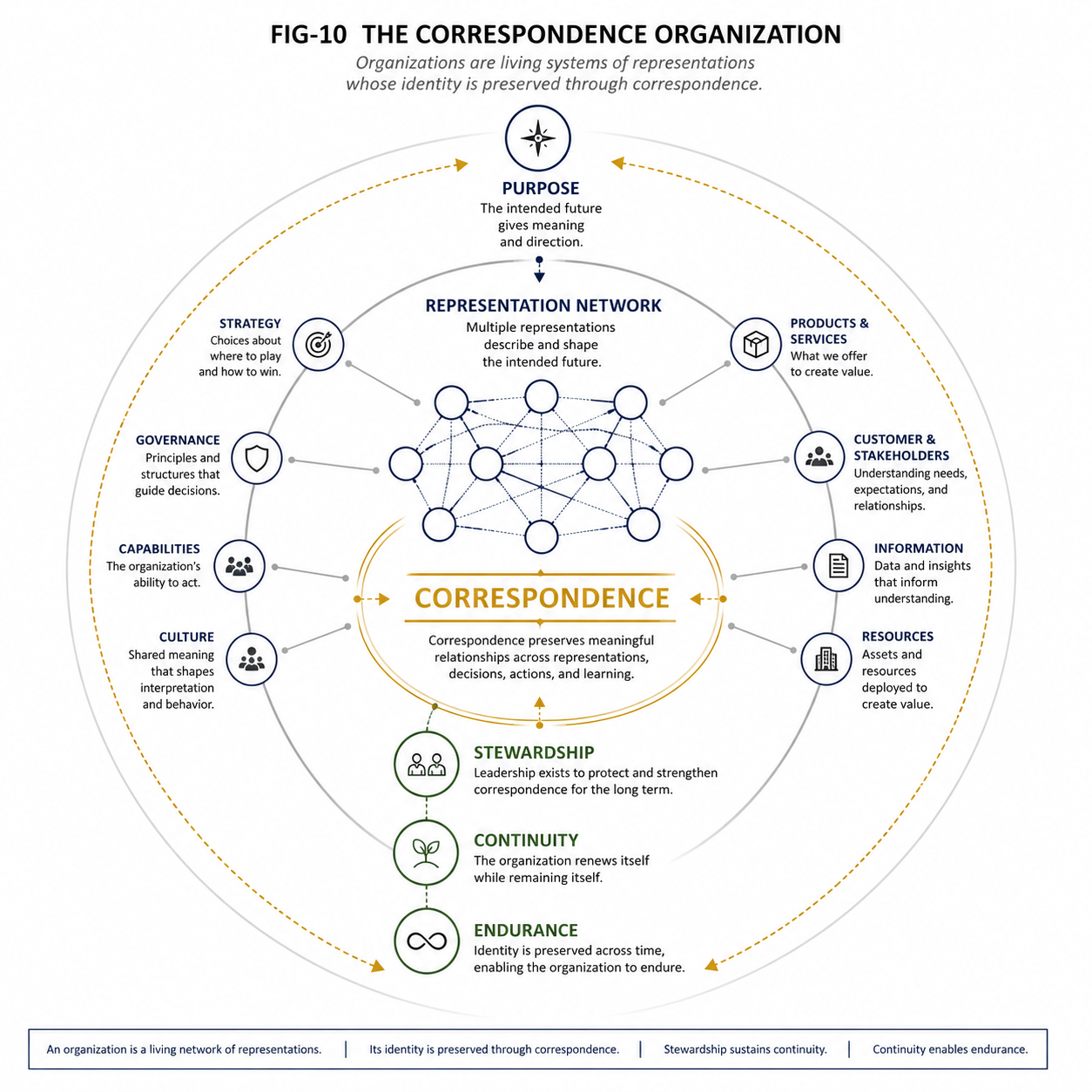
The Correspondence Organization. Purpose provides direction. Representations express organizational understanding. Representation Networks connect meaning. Correspondence preserves those relationships. Sustained Correspondence gives rise to Cognitive Integrity. Stewardship protects that integrity. Organizational Wisdom emerges over time. Together these elements enable organizations to adapt continuously without losing their identity.
Organizations as Living Cognitive Systems
Traditional management often understands organizations as administrative systems in which people perform work, processes coordinate activity, and technology supports execution. The Correspondence perspective proposes something different. Organizations are living cognitive systems, not because organizations possess minds, but because they continuously create, interpret, preserve, revise, and reconnect representations. Purpose becomes organizational intent. Strategies become evolving hypotheses. Decisions become commitments. Actions become experiments. Learning becomes adaptation. Memory becomes continuity. Organizational understanding does not reside inside any individual representation or any individual person. It emerges from the relationships continuously connecting the Representation Network. Organizations think because those relationships remain meaningful.
Identity Through Change
One of the oldest philosophical questions asks:
What remains the same when everything changes?
Organizations confront that question every day. People join. People leave. Products evolve. Technologies are replaced. Markets shift. Strategies adapt. Artificial intelligence continuously reshapes organizational knowledge. Everything changes. Yet enduring organizations somehow remain recognizably themselves. The Correspondence perspective offers a different explanation. Identity is not preserved because structures remain stable. Identity is preserved because the relationships carrying organizational meaning remain coherent across change. Continuity resides in Correspondence. Not in stability.
AI-Native Organizations
Artificial intelligence makes this perspective increasingly important. Organizations now create representations at unprecedented speed. Strategies evolve continuously. Software generates documentation. AI agents recommend actions. Knowledge expands almost without limit. Without Correspondence, this acceleration produces fragmentation. Organizations become overwhelmed by disconnected organizational knowledge. With Correspondence, the opposite occurs. Artificial intelligence strengthens organizational understanding. Relationships become more visible. Learning compounds more rapidly. Stewardship becomes increasingly effective. The defining capability of AI-native organizations will therefore not be the quantity of artificial intelligence they deploy. It will be their ability to preserve meaningful relationships while humans and AI continuously reshape the Representation Network together. The Correspondence Organization is not defined by the technologies it adopts. It is defined by the relationships it continuously preserves.
A New Definition of Organizational Capability
Traditional management evaluates organizations through capabilities such as execution, innovation, efficiency, customer focus, and operational excellence. These remain valuable. The Correspondence perspective introduces another capability: the ability to preserve meaningful relationships while continuously changing. Everything else depends upon this foundation. Learning, leadership, governance, and artificial intelligence all depend upon it. Without Correspondence, every capability gradually weakens. With Correspondence, capabilities reinforce one another. The organization becomes increasingly coherent as it evolves.
More Than a Framework
The Correspondence Organization is not another organizational model competing with existing management theories. It is an explanatory model. It seeks to explain why organizations remember, why they drift, why they learn, why they preserve identity, and why artificial intelligence strengthens some organizations while fragmenting others. Most importantly, it proposes a different unit of organizational understanding: meaningful relationships rather than departments, processes, or technology. Once those relationships become visible, organizations begin to look fundamentally different.
Looking Forward
Every enduring management theory changes what leaders notice. Scientific Management made work visible. Systems Thinking made feedback visible. Knowledge Management made knowledge visible. The Correspondence perspective makes organizational meaning visible. Once leaders begin seeing organizations this way, familiar problems become easier to understand. Transformation becomes the redesign of relationships. Leadership becomes stewardship. Artificial intelligence becomes participation. Learning becomes cumulative. Organizations become living cognitive systems rather than static administrative structures. This shift is more than conceptual. It changes how organizations are designed, how they are governed, how they adapt, and ultimately how they endure.
Toward a New Discipline
The Correspondence Organization is not the conclusion of this journey. It is the moment when every idea introduced throughout this book becomes part of one coherent model. The remaining chapters look beyond organizations themselves and ask a broader question. If organizations can be understood through Correspondence, what does this mean for organizational science? Can Correspondence become more than a theory? Can it become the foundation of a new discipline? That possibility is the subject of the next chapter.