The Meeting That Should Not Have Failed
"Organizations do not fail because people lack intelligence, effort, or good intentions. They fail because something invisible gradually disconnects intention from execution."
Every Organization Has Attended This Meeting
Every organization has attended this meeting, although not necessarily in the same room, with the same people, or in the same industry. Almost every leadership team eventually experiences the unsettling realization that intelligent people, acting with good intentions, are somehow no longer working within the same organization. The meeting itself is rarely the problem. It merely reveals one.
Monday Morning
The executive team gathered around the conference table as they had every Monday for years. The agenda looked familiar: strategy updates, operational performance, customer feedback, delivery risks, and financial forecasts. Nothing about the meeting suggested that it would be remembered. The room was filled with capable people. The strategy had been carefully developed, budgets had been approved, projects were progressing, and the dashboards looked healthy. Every executive present had years, and in some cases decades, of experience. By every conventional measure, this was a well-managed organization. Everyone around the table was discussing the visible organization: sales, operations, technology, finance, projects, and performance. None of them realized that another organization—one with no organizational chart, no department names, and no reporting lines—was quietly shaping every conversation in the room.
Within the first twenty minutes, something unsettling became impossible to ignore. The marketing team described one set of priorities, while operations described another. Technology had optimized for objectives that nobody else mentioned. Customer support was solving problems created by decisions no one remembered making. Finance presented numbers that were technically correct but answered questions nobody had asked. Every report was accurate, every participant was competent, and every team was acting responsibly. Nothing appeared broken. And yet the organization no longer seemed to be talking about the same organization. No one raised their voice, challenged the strategy, or questioned the competence of their colleagues. The meeting ended exactly on time. Everyone left believing they had done their job, and yet everyone carried away the same quiet feeling that something important had slipped through the cracks.
The Explanation We Usually Give
Most organizations explain meetings like this in remarkably similar ways: communication needs to improve, leadership needs to become stronger, processes need to be standardized, governance needs to be tightened, employees need more training, or the organization needs better software. A new transformation program is launched, another dashboard is built, more meetings are scheduled, and consultants are hired. For a while, things improve. Then, months later, the same patterns quietly return, not because people stopped caring or because the organization lacked talent, but because the underlying problem was never identified.
The Puzzle
Over the years I encountered this pattern repeatedly across different industries, countries, technologies, and leadership teams. Some organizations were growing rapidly. Others were struggling. Some had embraced artificial intelligence. Others still relied largely on traditional management. The details changed; the pattern did not. Good people made thoughtful decisions. Those decisions produced reasonable actions, and those actions produced measurable outcomes. Yet the organization gradually became less coherent. The more I observed this phenomenon, the more a different question began to emerge. Perhaps organizations do not lose their way because they make bad decisions. Perhaps they lose their way because good decisions slowly become disconnected from one another.
A Different Question
Management has spent decades asking important questions. How should organizations plan, coordinate, learn, process information, and make decisions? These questions matter. This book asks a different one.
How does an organization preserve the relationships that give all of those activities meaning?
The challenge is not producing a strategy; it is ensuring that strategy remains connected to thousands of decisions made over months and years. The challenge is not completing projects; it is ensuring that those projects remain connected to the purpose that justified them. The challenge is not collecting lessons learned; it is ensuring those lessons continue shaping future decisions. When these relationships weaken, organizations rarely collapse overnight. Instead, they drift quietly, gradually, and almost invisibly.
Why This Matters Now
This question has become increasingly important as organizations become AI-native. Artificial intelligence can generate plans, recommendations, analyses, summaries, forecasts, software, policies, presentations, and decisions at extraordinary speed. The volume of organizational knowledge is growing faster than at any point in history. But producing more information is not the same as producing greater understanding. An organization can generate millions of documents while becoming less coherent. It can automate thousands of decisions while becoming less aligned. It can accelerate execution while quietly losing sight of why it is executing in the first place. Technology has accelerated organizational activity. It has not automatically preserved organizational meaning. In many organizations, the opposite is happening: information is increasing while meaning fragments.
The Invisible Organization
Every organization has visible structures: organizational charts, processes, projects, budgets, technology platforms, policies, and performance indicators. These are the things we manage. But behind every visible organization exists another organization, an invisible one. It is not made of departments or reporting lines. It is made of meaning. It exists in the relationships between strategies, decisions, commitments, conversations, software systems, documents, observations, and memories. It cannot be seen directly. Yet it determines whether the visible organization remains coherent as it changes. When this invisible organization remains healthy, change strengthens the organization. When it weakens, even successful initiatives begin pulling in different directions. The visible organization continues operating. The invisible organization slowly falls apart.
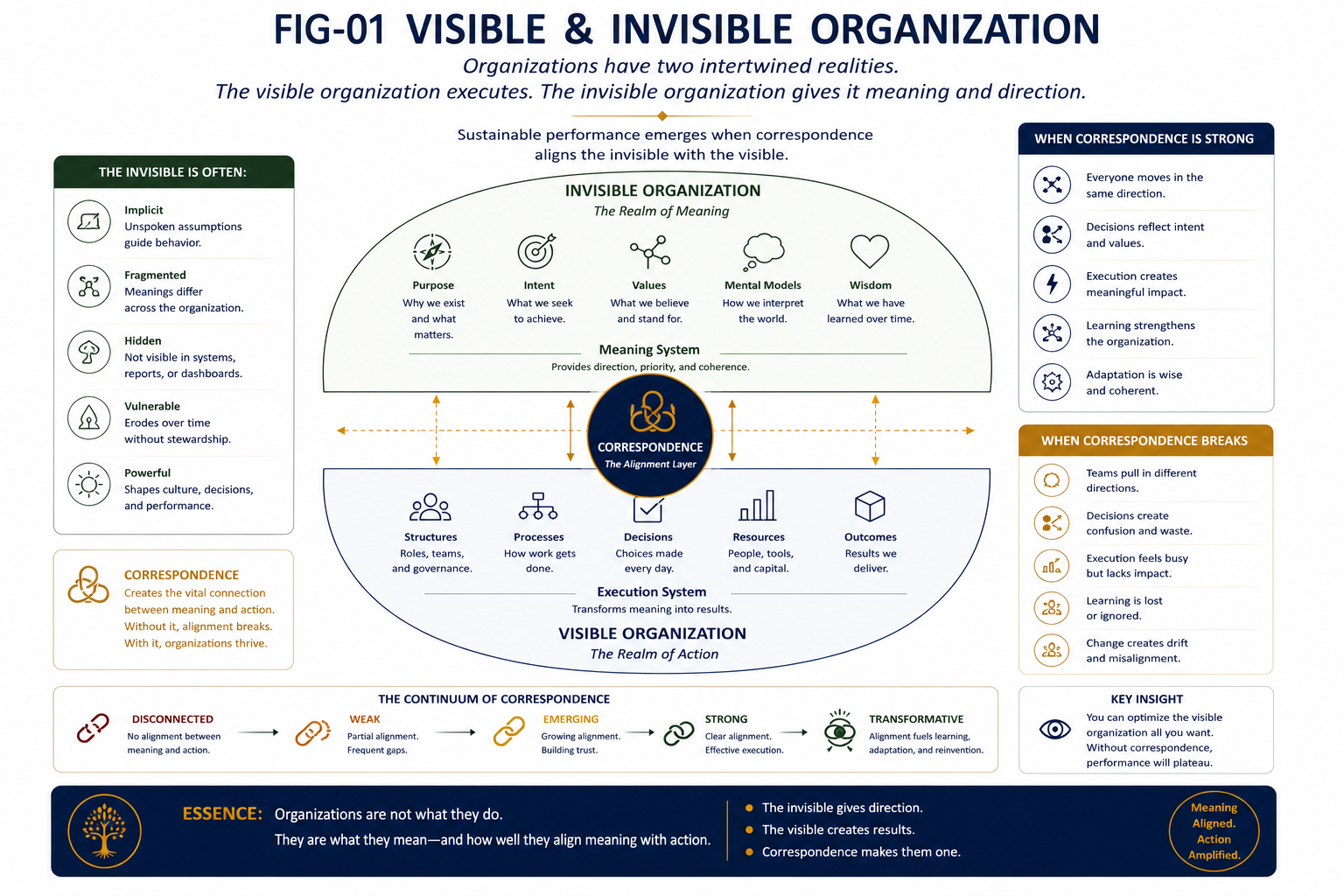
The visible organization includes structures, processes, systems, reporting relationships, and observable activity. The invisible organization consists of the meanings and relationships that connect purpose, strategy, decisions, actions, learning, and memory. Throughout this book, we will explore how the health of the visible organization depends upon the coherence of the invisible one.
Looking Differently
Most management thinking begins with what organizations produce: strategies, processes, structures, policies, technology, and performance. This book begins somewhere else. It begins with the relationships that connect those things. The visible organization tells us what exists. The invisible organization explains why it continues to function as a coherent whole. The distinction may seem subtle. Its implications are profound. If organizations are held together not merely by structures but by meaningful relationships, then preserving those relationships becomes one of the central responsibilities of leadership. It also becomes one of the defining challenges of AI-native organizations.
The Journey Begins
We have become remarkably good at designing organizations we can see. We redesign structures, optimize processes, modernize technology, and measure performance. Yet the meeting that opened this book suggests that something essential lies beyond all of these. Before we can understand why organizations drift, forget, or lose coherence, we must first learn to see the organization that rarely appears on an organizational chart. It has always existed; we have simply lacked the language to describe it. Figure 1 offers the first glimpse of that invisible organization. The rest of the book asks what it takes to preserve it.