Cars on Dirt Roads
A fast car on a dirt road is still constrained by the road. The engine may be powerful, the driver skilled, and the destination clear, but the surrounding infrastructure determines how much of that capability becomes useful motion. This is the simplest way to understand many AI initiatives. The tool is not weak. The environment around the tool is underdesigned. Advanced capability enters a road system of handoffs, approvals, data gaps, trust problems, and inherited work practices. Leaders often attribute technology value to the tool itself.
The larger shift is that capability becomes valuable only when the infrastructure around it is redesigned. The first automobiles did not immediately transform transportation.
They were often slower than horses on existing roads. They broke down more frequently. They were expensive, difficult to maintain, and practical only in limited situations. Looking back, it is tempting to conclude that the automobile simply was not ready. History tells a different story. The automobile was ready. The infrastructure was not. Roads were designed for horses and wagons, not motor vehicles. Fuel stations did not exist. Traffic rules had not yet been established. Driver education was almost nonexistent. Maintenance networks had to be invented. Insurance systems had to evolve.
The technology arrived before the operating environment that allowed it to reach its full potential. The breakthrough did not occur because automobiles became dramatically different. It occurred because society redesigned everything around them.
Roads became highways. Villages became connected by national infrastructure. Fuel became widely available. Traffic systems emerged. An entirely new transportation operating system evolved. Only then did the true value of the automobile become obvious. Artificial intelligence is following a remarkably similar path. Organizations often evaluate AI as though it were the automobile on a muddy road. They ask whether it is fast enough, reliable enough, accurate enough, and productive enough. These are understandable questions. They are also the wrong questions.
The real question is whether the organization surrounding artificial intelligence was designed for the capabilities it introduces. Most organizations still operate on infrastructure designed for human execution. Processes assume people perform every task. Workflows assume information moves from one individual to another.
Approvals assume every important decision requires sequential review. Management assumes coordination depends primarily on people communicating with people. Artificial intelligence changes those assumptions. Yet the surrounding infrastructure often remains unchanged. A useful modern example comes from a technology that is not generative AI at all: UPS's ORION route-optimization system. The system became valuable not merely because an algorithm could calculate routes, but because UPS had to build and adapt the operational infrastructure around it. Public case material describes years of development, investment, management-practice change, driver acceptance, data validation, and new metrics.
The lesson is not that every organization should imitate UPS. It is that advanced capability creates value only when the operating environment is redesigned to make that capability usable.
Figure 3.1 turns the road metaphor into the chapter's operating distinction: capability and infrastructure are different sources of value.
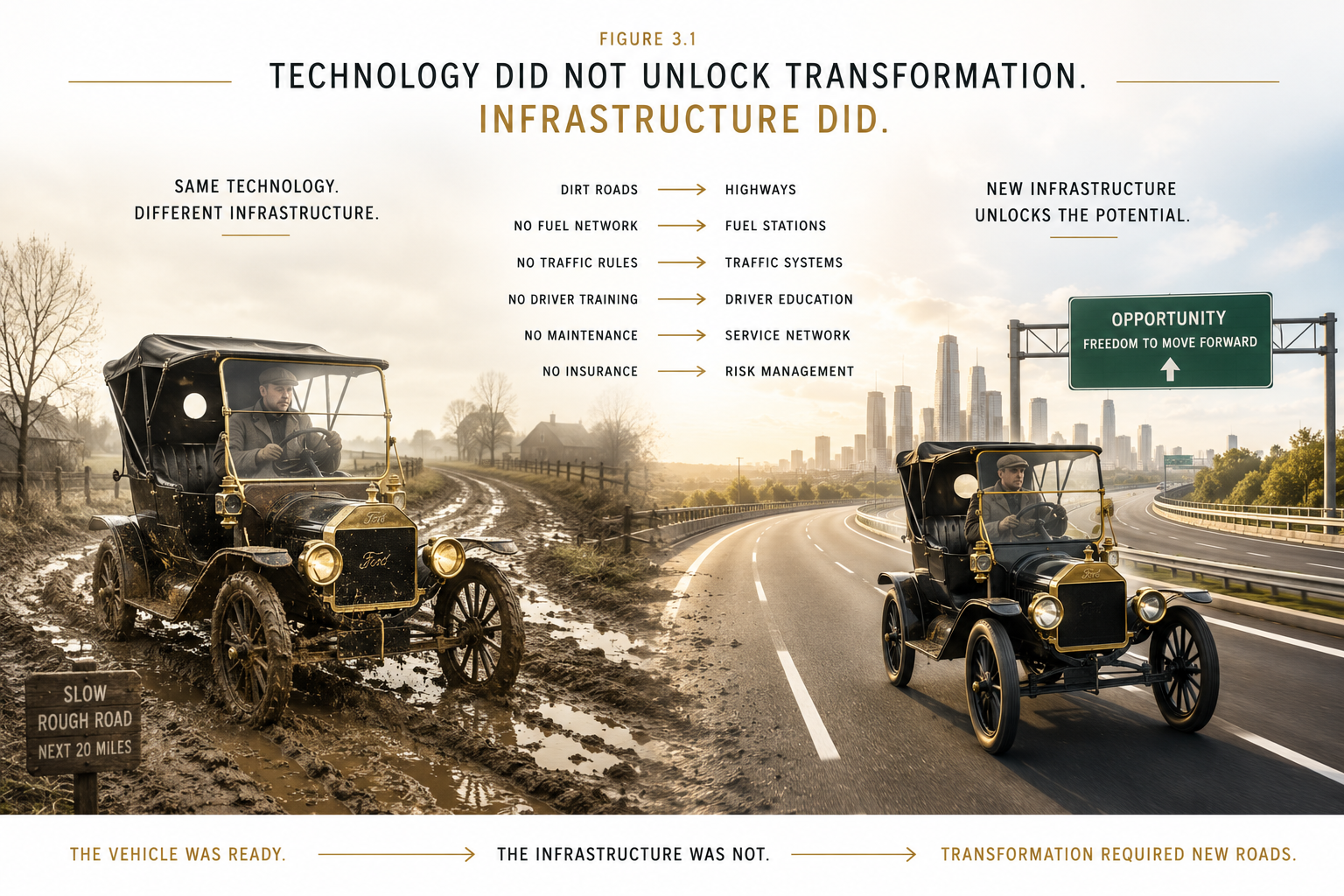
Artificial intelligence follows the same pattern. Technology alone does not create transformation. Infrastructure does.
The figure separates technical capability from usable organizational capability. The second road is not better technology alone; it is the infrastructure that lets technology matter.
Imagine placing a modern sports car on a narrow dirt road. Its engine remains extraordinary. Its engineering remains world class. Its potential has not changed. Yet almost none of that potential can be realized. The limitation is no longer the vehicle. It is the road beneath it. The same principle applies inside organizations. Artificial intelligence is increasingly capable of continuous reasoning, analysis, coordination, and execution. But organizations continue asking it to operate within workflows designed for a completely different era. As a result, AI often appears less transformative than expected.
The limitation is not the capability itself; it is the environment surrounding that capability. This creates a common misunderstanding. Organizations conclude they need better AI. In reality, they often need better organizational infrastructure.
The first instinct is usually to improve the existing roads. Add another workflow. Introduce another approval. Create another dashboard. Improve another process. Each improvement appears sensible. Each improvement makes the existing infrastructure marginally better. Yet none addresses the underlying problem. The road itself belongs to another era. Eventually every technological revolution reaches this point. The existing infrastructure becomes the greatest obstacle to the technology it was supposed to support. That is precisely where organizations now find themselves with artificial intelligence. The question is no longer how to improve the old road; it is whether a different road should exist altogether. Figure 3.2 makes that choice explicit.
Leaders can spend the next decade smoothing the old road, or they can ask what kind of road this new capability actually requires.
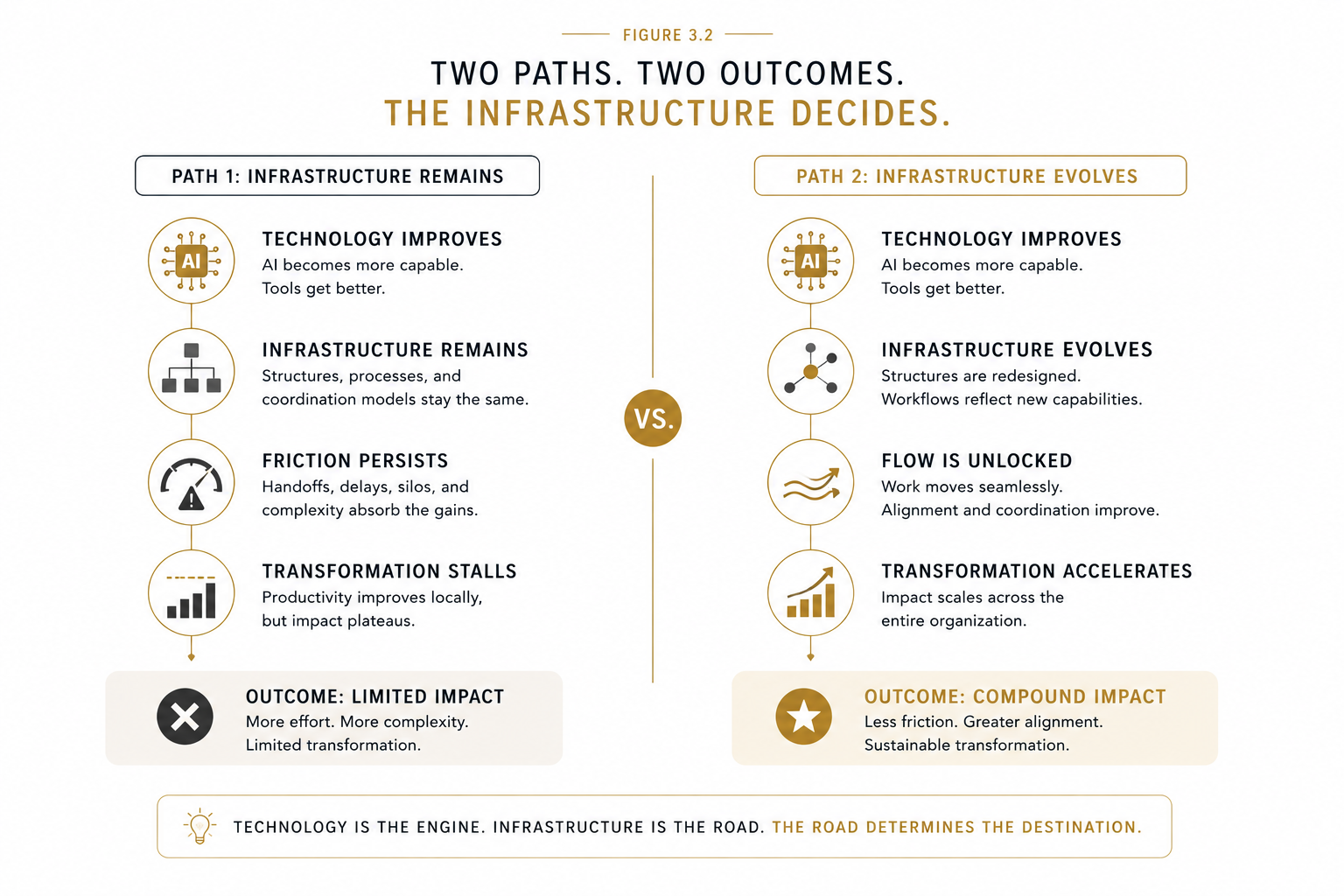
The technology is the same. The outcome is fundamentally different.
The second figure turns the metaphor into a leadership choice. One path improves the inherited road; the other asks what kind of road the new capability actually requires.
The choice facing organizations is surprisingly simple. One path continues optimizing existing structures. Artificial intelligence increases productivity. Processes become faster. Reports become richer. Automation expands. Yet complexity grows alongside it. The organization works harder to coordinate increasingly efficient activity. The second path begins somewhere else. Instead of asking how to automate existing work, leaders ask why the work exists in its current form. Instead of improving coordination, they redesign how coordination happens. Instead of accelerating the operating system, they redesign it. The result is not simply greater productivity. It is a different kind of organization.
History demonstrates this repeatedly. Railroads required new logistics. Electricity required redesigned factories. The internet required redesigned business models. Artificial intelligence requires redesigned organizations.
This is why comparing AI tools misses the larger story. The defining competitive advantage of the coming decade will not belong to organizations with marginally better models. It will belong to organizations that redesign the infrastructure surrounding those models. The winners will not simply own faster cars. They will build better roads. That is the operating system shift. It is not primarily about technology. It is about creating the organizational infrastructure that allows technology to realize its full potential. Every technological revolution eventually reaches the same moment.
The old infrastructure becomes the greatest obstacle to the new capability. Artificial intelligence has reached that moment. The question is no longer whether organizations should adopt AI; it is whether they are willing to redesign the roads on which it must travel. The lesson is practical: before leaders ask how much capability a technology contains, they should ask whether the organization has built the road on which that capability can travel.