The Interface Illusion
For decades, the screen has been the place where organizations met their systems. People clicked, typed, searched, submitted, approved, and retrieved information. The interface translated human intention into software action. Artificial intelligence changes that relationship. The central question is no longer only whether the screen is usable; it is whether the organization can understand intent well enough for intelligent systems to act in ways that remain aligned, governed, and accountable. Cleaner applications and better user experiences still matter, but the decisive interface is the organization's ability to understand and execute human intent.
For decades, digital transformation focused on improving interfaces: better dashboards, better applications, better reports, better user experiences, and better screens. Organizations invested enormous resources into making software easier for people to use. This made perfect sense. Software required people to understand how machines worked. Users learned menus, buttons, forms, commands, navigation, search, and configuration. The interface became the bridge between human thinking and machine execution. It was never the work itself. It was a translation layer. People translated their intentions into instructions the system could understand. The software translated those instructions into actions.
This model defined how organizations interacted with technology until artificial intelligence began changing the translation itself.
People no longer need to think like software. They increasingly communicate as they think: describing goals, expressing intent, explaining context, and defining outcomes while the artificial intelligence performs the translation.
One of the oldest assumptions in enterprise software begins to reverse. Historically, humans adapted to systems; increasingly, systems adapt to humans. This is far more significant than a better user experience. It changes the role of software itself. Applications become less important than orchestration. Navigation becomes less important than understanding. Interfaces become less important than intent. The emerging language of agents makes this shift easier to see. Microsoft describes a progression in which AI first assists people, then joins teams as digital colleagues, and eventually takes on more complex workflows under human direction.
Whether that forecast matures exactly as described is less important than the direction it signals.
The interface is moving away from "which application do I open?" and toward "what outcome am I trying to create?" Figure 6.1 captures this reversal: the old interface forced people to translate intent into system actions, while the new interface asks systems to translate intent into coordinated action.
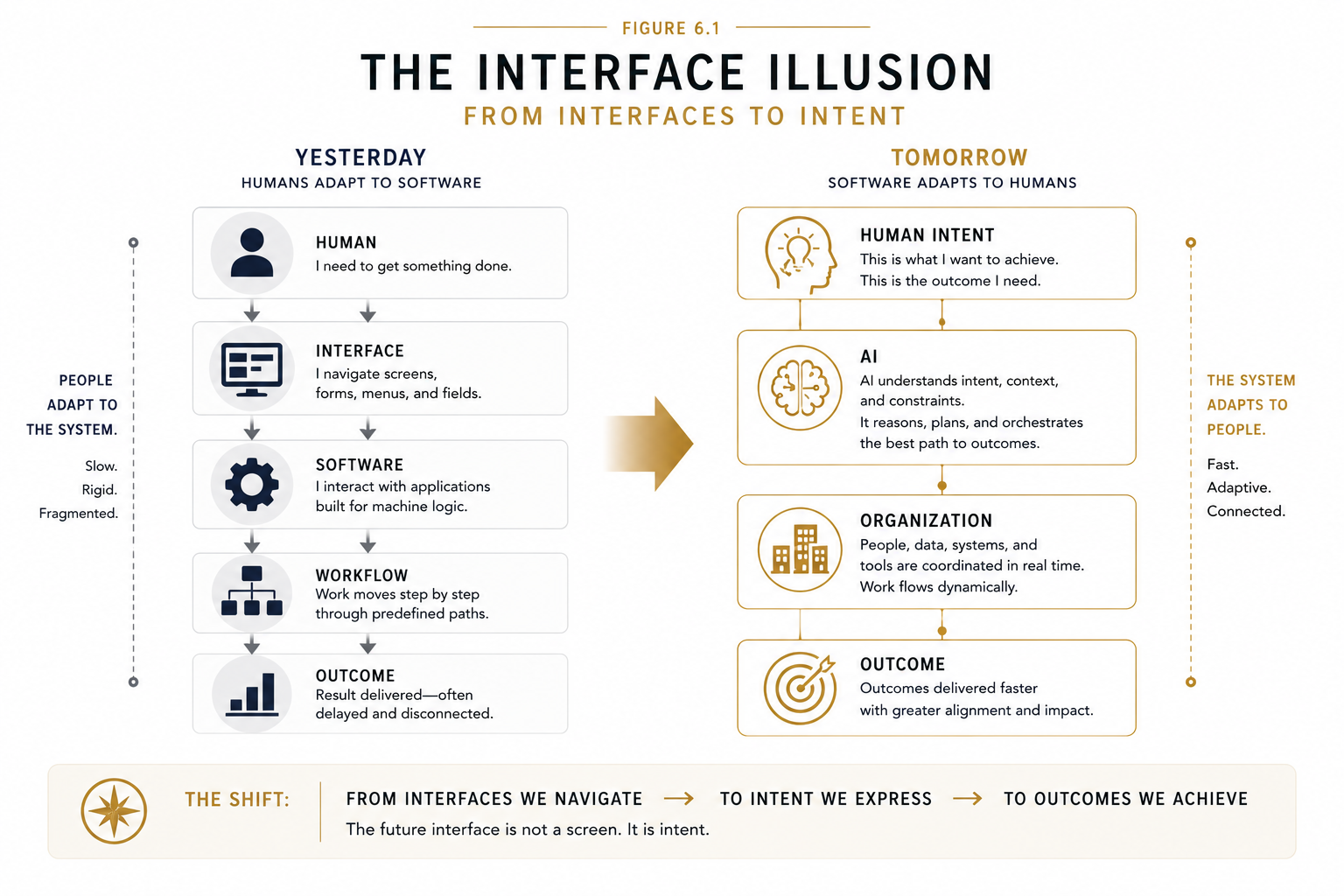
AI-native organizations reverse the relationship: systems understand human intent and orchestrate execution.
This figure warns against interface-centered thinking. If intent remains poorly understood, even an elegant interface leaves the operating problem intact.
This explains why many discussions about AI focus on the wrong question. Organizations ask whether employees will continue using dashboards, whether people will still open enterprise applications, and whether existing user interfaces remain relevant. Those questions assume the interface remains the center of organizational interaction. It does not. Interaction increases, while interfaces become less visible. The distinction matters. People still collaborate, make decisions, define priorities, and create strategy. What changes is the amount of software navigation required between intention and execution.
Instead of opening multiple applications, locating information, configuring workflows, and manually coordinating work, people increasingly express what they want to achieve. Artificial intelligence determines how that outcome can best be produced. The interface gradually fades into the background.
Intent moves to the foreground. This does not eliminate software. Organizations will continue using enterprise systems. Data platforms, ERP, CRM, financial systems, and operational technologies remain essential. What changes is how people interact with them. Artificial intelligence becomes a universal translation layer. People communicate naturally while AI understands context, retrieves information, coordinates systems, plans execution, engages the appropriate tools, and produces results. The software continues performing its role. People simply interact with it differently. This represents a profound shift in organizational interaction. For decades, organizations trained people to understand software. Increasingly, software must understand people.
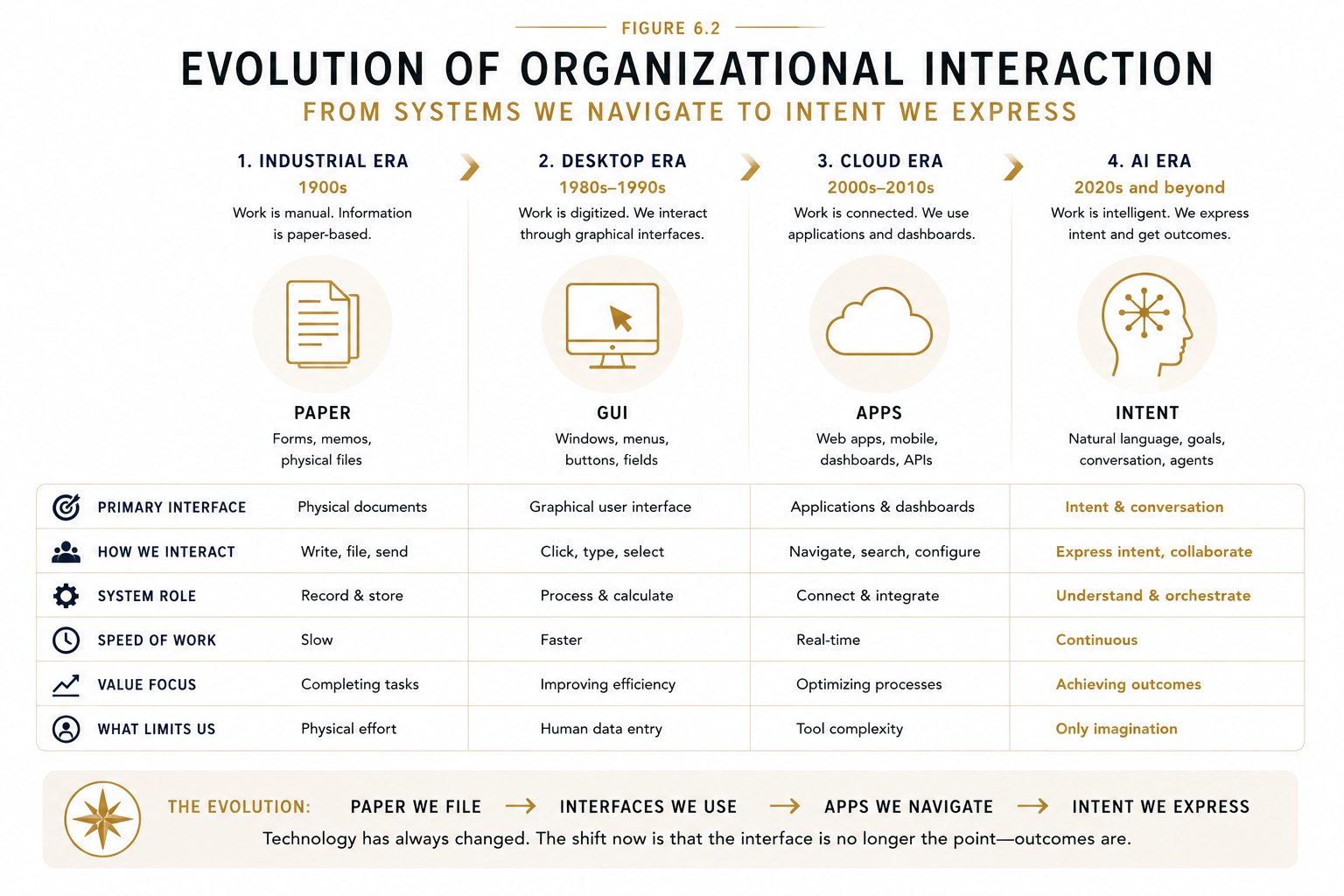
Artificial intelligence changes it again, not by introducing another application, but by making human intent the primary interface.
The evolution figure shows that the interface is moving from screens toward governed intent. The question becomes how faithfully the organization can translate intention into action.
The economics of enterprise software begin to change. Historically, organizations invested heavily in simplifying interfaces. Menus became graphical. Applications became web-based. Mobile experiences improved. Dashboards became interactive. Each generation reduced the effort required to navigate software. Artificial intelligence changes the objective entirely. The goal is no longer easier navigation. The goal is eliminating unnecessary navigation. Software increasingly becomes an invisible capability rather than a visible destination. Employees stop thinking about applications. They think about outcomes.
They no longer ask, "Which system should I use?" They ask, "How do I achieve this?" Artificial intelligence increasingly determines the rest.
The interface has not simply become more sophisticated; it has become less central. This is the interface illusion. Many organizations believe they are transforming because they deploy AI inside existing applications.
In reality, the larger transformation occurs when applications stop defining how work is organized. Intent becomes the organizing principle. Software becomes supporting infrastructure. Artificial intelligence becomes the translation layer connecting people, systems, and execution. The shift reaches beyond technology into management itself. Leaders no longer need to think primarily in terms of systems. They increasingly think in terms of intent. Teams no longer organize work around applications. They organize around outcomes. Organizations no longer optimize navigation. They optimize understanding. The most important future interface is less likely to be another dashboard.
It is the ability to express intent clearly and allow intelligent systems to transform that intent into coordinated action. The interface recedes from the center of attention, and the interaction becomes more human than ever. That is the paradox of artificial intelligence. The more intelligent technology becomes, the less people need to think like machines. The operating system shift is therefore not the replacement of one interface with another. It is the transition from navigating software to expressing intent. The interface illusion breaks when leaders realize that the best interface is not the most elegant screen. It is the most faithful translation of intent into action.
Executive Takeaway
The interface of the AI era is not a screen. It is intent. The most valuable organizations will not build better interfaces; they will build better ways of understanding and executing human intent.