The Operating System Shift
By the end of an era, the old operating system can still look functional. Work continues. Meetings happen. Dashboards update. Strategy cycles proceed. The danger is not collapse. The danger is that the organization keeps improving a model whose assumptions no longer fit the environment. That is why the operating system shift is not an abstract idea. It is the name for a leadership choice already taking shape: whether to keep adding AI to the organization we inherited, or to redesign the organization around the capabilities now available.
If AI transformation is treated as another implementation program, leaders will miss the nature of the change. The operating system shift is a continuing leadership journey.
Every generation inherits organizations designed for the world that came before it. The Industrial Revolution created organizations optimized for physical production. The Information Age redesigned them around information, specialization, and digital technology. Today, artificial intelligence is changing the assumptions that define organizational success once again. As every previous chapter has shown, this transformation is not simply technological. It is organizational. Artificial intelligence does not merely change how work is performed. It changes what organizations are capable of becoming. The operating system must change because the environment in which it operates has changed.
This is the operating system shift. It is not another digital transformation initiative, another software implementation, or another productivity program. It is the redesign of how organizations create value. Throughout this book we have explored that transformation from multiple perspectives. We began by recognizing that the existing operating system no longer reflects the realities of the AI era. Organizations designed around human constraints increasingly struggle in a world where intelligence, information, and execution have become abundant. We examined why productivity improvements alone cannot solve structural problems, why accelerating yesterday's organization can amplify its weaknesses, why artificial intelligence compresses organizational distance, why traditional workflows increasingly disappear, why interfaces become less important than intent, why leadership shifts from directing execution toward defining purpose, why governance evolves from supervision toward continuous alignment, why human contribution migrates toward judgment and learning, and why preserving expertise becomes one of the defining organizational responsibilities of the coming decades.
Each chapter described one part of the transformation. Together they describe an entirely different organizational operating system. The cases and public evidence considered along the way do not prove that this future has fully arrived. They show something more useful for leaders: the pattern is already visible in fragments. Productivity gains are real but uneven. Workflow redesign matters. Governance is becoming more continuous. Human-agent work is emerging. Operational infrastructure determines whether capability becomes value. The operating system shift is therefore not a speculative abstraction. It is a name for a set of pressures leaders are already beginning to feel. Figure 14.1 gathers those pressures into the book's final synthesis.
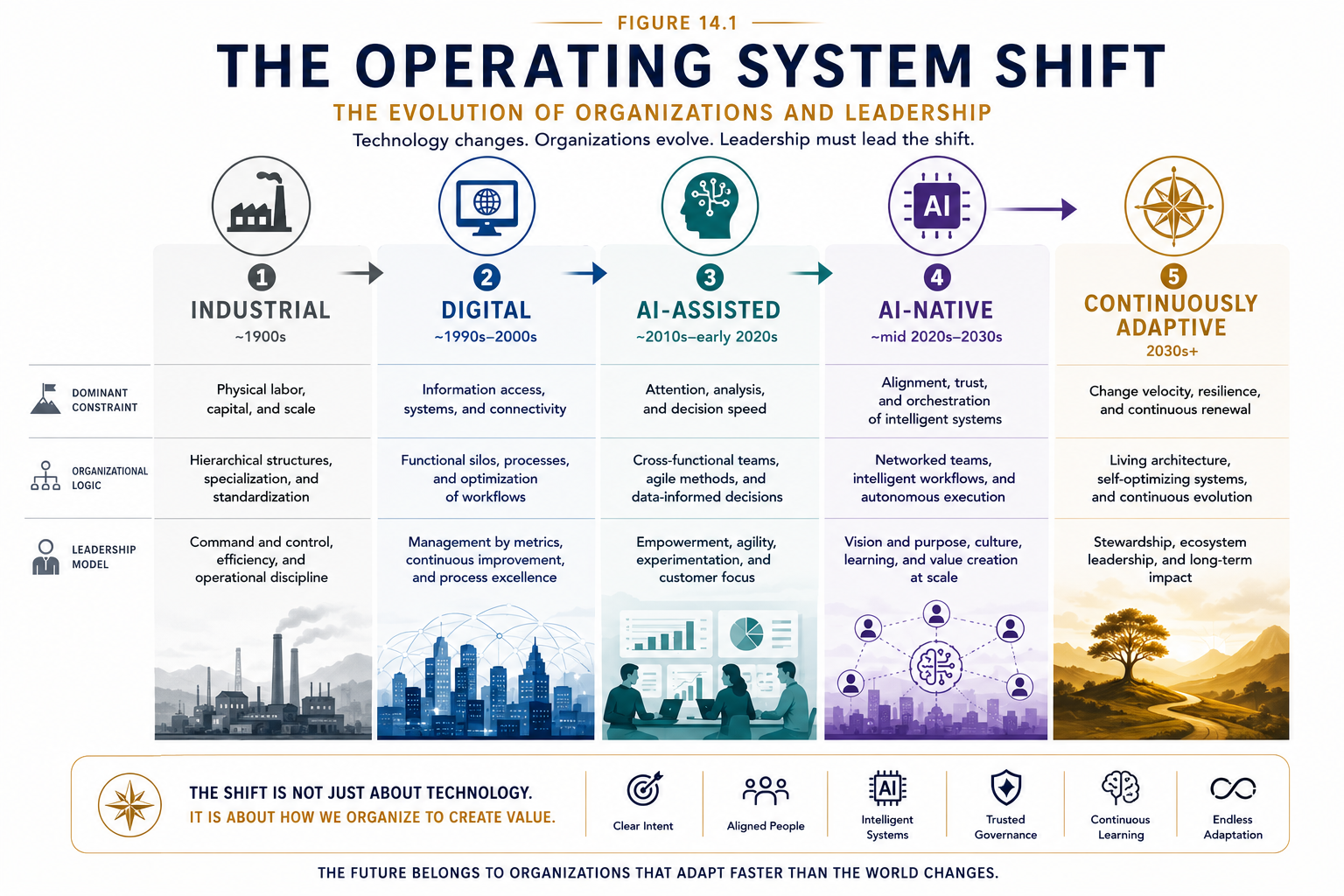
The AI era is not simply another technology cycle; it represents the emergence of a new operating system for organizations built around intelligence, adaptability, and continuous evolution.
Read this synthesis as the book's era-level argument. It does not claim that technology alone creates a new era; it shows that technology cycles become organizational shifts when the dominant constraint moves and leaders redesign around it.
Recognizing this transformation is only the beginning. Leadership determines whether organizations successfully navigate it. The central question is no longer: "Should we adopt artificial intelligence?" That question has largely been answered. The better question is: "What kind of organization do we want to build now that intelligent systems have become part of everyday work?" That question cannot be delegated. It cannot be answered by software vendors. It cannot be solved by technology alone. It is fundamentally a leadership question.
Every executive team must now decide which assumptions of the previous operating system still deserve preservation, which should evolve, and which should be left behind entirely. This demands courage, not only because technology is uncertain, but because redesigning organizations requires rethinking habits that have guided management for generations. The leaders who thrive will not simply implement artificial intelligence. They will redesign the systems through which people and intelligent systems create value together. Transformation therefore becomes an ongoing capability rather than a one-time project.
Organizations continually recognize change, rethink assumptions, redesign structures, realign people and systems, govern through adaptive principles, learn continuously, evolve deliberately, and then begin the cycle again. The operating system is never finished. It grows stronger through continuous refinement.
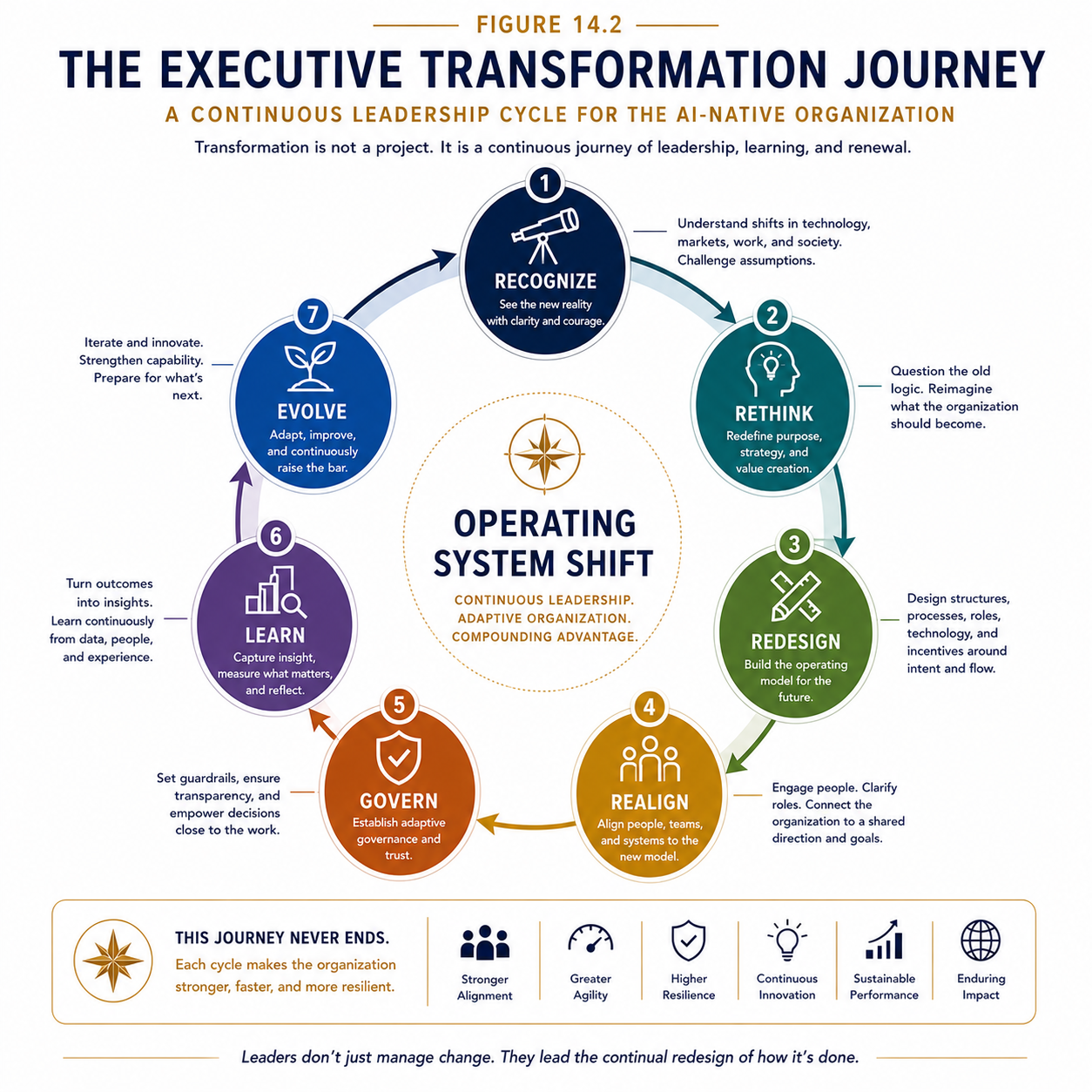
Organizations repeatedly recognize change, rethink assumptions, redesign their operating model, realign people and systems, govern adaptively, learn continuously, and evolve with every cycle.
The journey figure turns the book's argument into a recurring leadership discipline: recognize, rethink, redesign, realign, govern, learn, and evolve. It does not present transformation as a finished destination; it gives executives a cycle for sustaining alignment as the operating system continues to change.
This continuous journey changes how organizations think about competitive success. Success no longer belongs to those who simply possess better technology. Technology quickly becomes accessible to everyone. Competitive advantage increasingly belongs to organizations that learn faster, adapt more effectively, maintain stronger alignment, integrate people and intelligent systems more successfully, and improve continuously. The operating system itself becomes the competitive advantage. This transformation also changes how we think about people. Artificial intelligence does not diminish human importance. It elevates it.
As intelligent systems assume greater responsibility for execution, uniquely human capabilities become increasingly valuable: purpose, judgment, creativity, empathy, ethics, and leadership. These are not secondary capabilities. They become the defining strengths of successful organizations. Technology expands organizational capability. Human beings determine what those capabilities should accomplish. This relationship will define the organizations that shape the coming decades. Ultimately, the operating system shift extends far beyond business. Organizations shape how societies create value. They influence healthcare, education, government, scientific discovery, manufacturing, and infrastructure. Every institution that coordinates people toward shared outcomes depends upon organizational design. Improving organizations therefore improves much more than business performance. It improves humanity's ability to solve increasingly complex problems together. Few generations receive the opportunity to redesign the foundations of organizational life. Ours does.
The choices leaders make today will influence how millions of people work, collaborate, innovate, and create value for decades to come. That responsibility should inspire both humility and optimism. The future is not predetermined by technology. It will be shaped by the organizations we choose to build around it. The operating system shift has already begun. The only remaining question is who will lead it. That is the book's final claim: the AI era will be shaped less by the intelligence organizations buy than by the organizations leaders choose to build.
Executive Takeaway
Artificial intelligence is not the transformation. The transformation is the organization we choose to build around it. The leaders of the AI era will be remembered not for deploying the most technology, but for redesigning organizations that continuously learn, adapt, and enable people and intelligent systems to create more value together than either could achieve alone.