Representation Networks
"Organizations do not think through individual representations. They think through the relationships between them."
The Missing Picture
By now we have identified the fundamental building blocks of organizational thought: strategies, policies, decisions, actions, outcomes, learning, and memory. Each is a representation. Each captures part of how an organization understands itself. Yet none explains the organization on its own. Imagine receiving every important representation your organization has ever created: every strategy, budget, board presentation, project plan, policy, meeting summary, customer insight, and AI-generated recommendation. You would possess an extraordinary amount of information. But one question would remain unanswered.
How do all of these belong to the same organization?
The answer cannot be found inside any individual representation. It exists in the relationships between them. Those relationships create something larger than the representations themselves. They create a network.
More Than a Collection
Most organizations manage knowledge as collections: folders, repositories, knowledge bases, content management systems, data lakes, and enterprise applications. Each organizes information into categories, placing strategies with strategies, policies with policies, projects with projects, and reports with reports. Collections make information easier to store, retrieve, and govern. But organizations do not think by moving through folders. They think by connecting meaning. The distinction is profound. Collections store; networks connect. Organizations require both, but only one explains organizational cognition. To understand organizations, we must therefore look beyond collections and begin seeing the network that connects them.
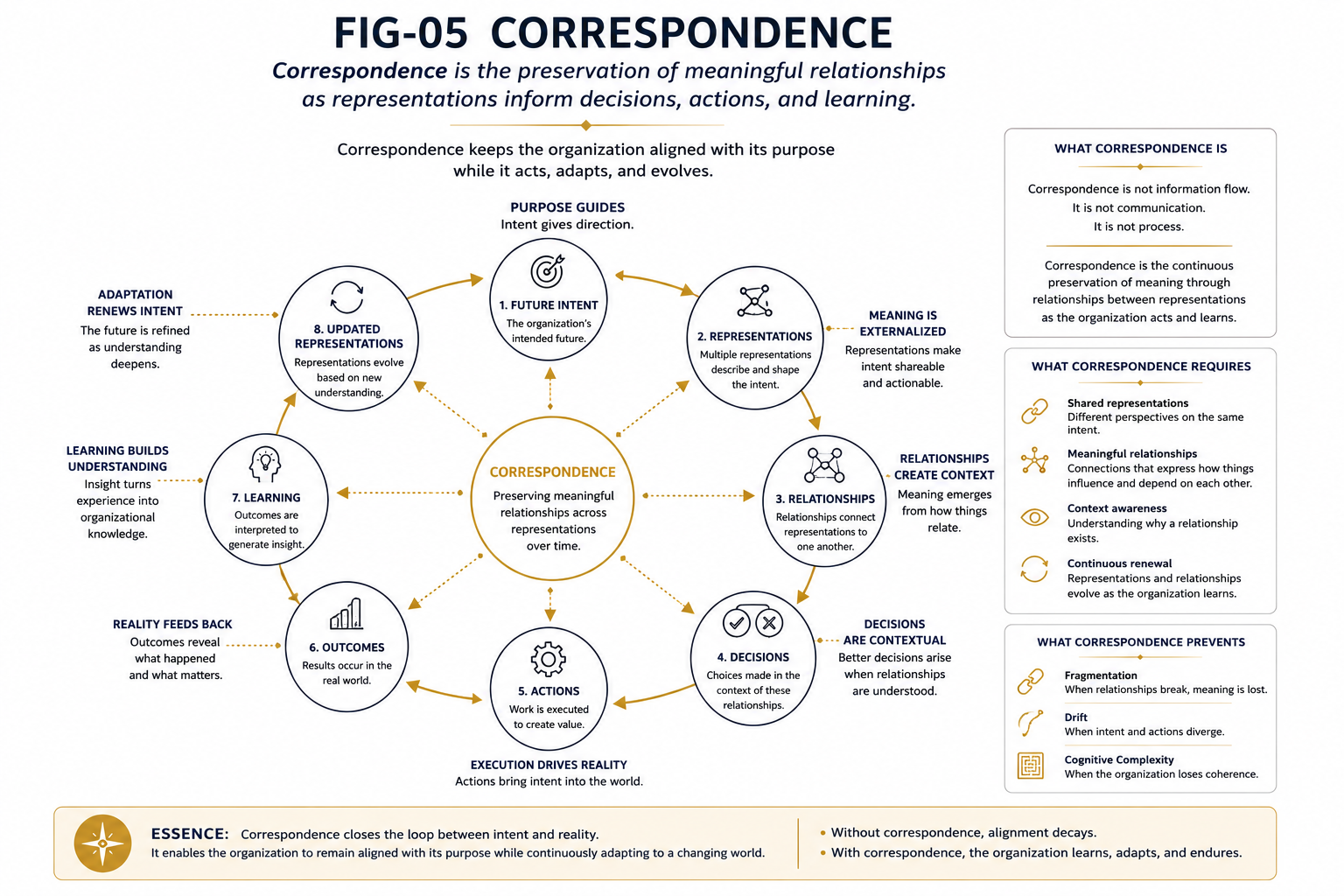
Representation Network. Individual representations rarely possess meaning in isolation. Organizational understanding emerges through the network of meaningful relationships connecting purpose, strategy, policies, decisions, actions, outcomes, learning, and memory. The Representation Network is the cognitive structure through which organizations think, remember, adapt, and evolve.
Every Representation Points Somewhere
No meaningful representation exists alone. Every one points beyond itself. A strategy points toward purpose. A policy points toward strategy. A decision points toward priorities. An action points toward a decision. An outcome points toward an action. A lesson points toward future choices. Each representation derives part of its meaning from the representations surrounding it. Imagine discovering a board decision made five years ago. Without knowing the strategic question it addressed, the assumptions that supported it, the projects that implemented it, the outcomes that followed, or the lessons the organization learned, the decision becomes little more than historical information. The document survives. Its meaning does not. Relationships transform isolated information into organizational understanding. No representation explains an organization. Networks do.
Organizations Think Through Networks
Individuals think, teams deliberate, and executives make decisions. Organizations think differently. No single individual understands everything the organization knows. No department possesses every relevant perspective. Organizational understanding emerges from interactions across the Representation Network. Purpose influences strategy, strategy shapes decisions, decisions guide action, actions produce outcomes, outcomes generate learning, and learning reshapes future strategy. The organization continuously reorganizes its own understanding because these relationships remain active. Thinking is not stored inside a department. It emerges across the network. Organizational intelligence is therefore not a property of individual representations. It is an emergent property of the relationships connecting them.
Why Networks Matter
Networks behave differently from collections. Adding another document to a repository changes very little. Adding a meaningful relationship changes the entire network. Organizations often celebrate growth in knowledge: more reports, more dashboards, more analyses, more AI-generated insights, and more documentation. Growth creates complexity; relationships create understanding. A thousand disconnected representations produce less organizational intelligence than a hundred representations connected through meaningful correspondence. The strength of an organization therefore depends less on the quantity of information than on the quality of the relationships that connect it.
AI Is Expanding the Network
Artificial intelligence is expanding Representation Networks at unprecedented speed. A single meeting now produces meeting summaries, action items, strategic observations, risk assessments, project updates, AI-generated recommendations, future scenarios, and entirely new representations that previously never existed. Every interaction enlarges the network. Every new representation introduces new relationships. The Representation Network is therefore growing faster than at any point in organizational history. This expansion is neither good nor bad. Its value depends entirely on whether the relationships within the network remain coherent as it grows. Artificial intelligence accelerates the creation of representations. It does not automatically preserve organizational understanding. That responsibility remains organizational.
A Living Cognitive System
Unlike an organizational chart, a Representation Network never stands still. Every decision reshapes it. Every customer interaction influences it. Every policy strengthens or weakens existing relationships. Every lesson reorganizes future understanding. Every interaction with artificial intelligence contributes to its evolution. The network is alive. Not because it possesses consciousness. But because it continuously reorganizes organizational meaning. Its identity does not arise from fixed structures. It emerges from the continuity of relationships across continuous change. That continuity allows organizations to remain recognizably themselves while constantly evolving.
A Different Unit of Analysis
Traditional management evaluates individual artifacts. Is the strategy effective? Is the dashboard accurate? Is the policy complete? These remain valuable questions, but the Correspondence perspective asks another.
How well is this representation connected to the rest of the organization?
That single question changes the unit of analysis. The organization is no longer understood primarily as a collection of documents, departments, or systems. It becomes a living network of representations. Learning emerges from the network. Memory emerges from the network. Adaptation emerges from the network. Leadership depends upon the network. Governance depends upon the network. Artificial intelligence becomes meaningful only within the network. Nothing can be fully understood in isolation. Everything depends upon the relationships that connect it.
The Missing Property
Representation Networks explain where organizational meaning exists. They do not yet explain why some organizations preserve that meaning while others gradually lose it. Two organizations may possess remarkably similar networks. One becomes increasingly coherent. The other slowly fragments. The difference cannot be explained by the representations themselves. Nor by the number of relationships they contain. It depends on whether those relationships continue preserving meaning as the organization changes. The central question therefore becomes unavoidable.
How does an organization preserve meaningful relationships through continuous change?
That property lies at the heart of this book. It is called Correspondence.