Representations
"Organizations do not think in documents. They think through representations."
The Building Blocks of Organizational Thought
By now we have encountered an invisible organization. We have seen that organizations remember. We have seen that they drift. Each idea points toward something more fundamental. Relationships. But relationships cannot exist on their own. They always connect something. Every strategy connects to a purpose. Every decision connects to a strategy. Every action connects to a decision. Every lesson connects to an outcome. If relationships are what hold organizations together, then a more fundamental question emerges.
What exactly are those relationships connecting?
The answer is surprisingly simple. Representations.
Organizations Think Through Representations
Every meeting leaves something behind: a decision, a policy, a roadmap, a budget, a customer promise, a product specification, an architectural principle, or an action plan. None of these is the organization itself. Yet together they become the organization's understanding of itself. Organizations rarely act directly upon reality. Reality is simply too complex. Instead, they create simplified expressions that allow thousands of people to coordinate around a shared understanding. These expressions are representations. A strategy is a representation. A budget is a representation. A roadmap is a representation. A customer journey is a representation. A policy is a representation. A contract is a representation. A dashboard is a representation. A meeting summary is a representation. Even this book is a representation. Organizations do not think in documents.
They think through representations. Representations make collective thinking possible.
The Map Is Not the Territory
Imagine planning a journey across a country. You would not carry the landscape with you. You would carry a map. The map is valuable precisely because it is not the territory. It simplifies reality. It emphasizes what matters. It ignores what does not. Every organizational representation works in exactly the same way. A strategy is not the future. A budget is not the organization. A dashboard is not performance. A customer survey is not the customer. A process diagram is not the work itself. Representations never replace reality. They make reality understandable. Their value comes not from completeness. It comes from meaningful simplification. To better understand this idea, consider the role representations play throughout organizational life.
Representations. Organizations continuously create representations that express intent, knowledge, decisions, actions, outcomes, and learning. These representations do not constitute reality itself. They provide meaningful views that enable organizations to think, coordinate, decide, and adapt collectively.
More Than Documents
Organizations often confuse representations with documents. Documents certainly contain representations. But representations are far broader. A spoken commitment. A design sketch. An engineering drawing. A customer conversation. A software model. A board decision. A product prototype. A machine-learning model. An architectural principle. Even a conversation can become a representation if it changes how the organization understands itself. The medium is not what matters. Meaning is. Representations exist wherever organizational understanding is expressed. Some persist for decades. Others exist only for minutes. Some are created by people. Others emerge through artificial intelligence. The organization thinks through all of them.
AI Is Creating Representations at an Unprecedented Scale
Artificial intelligence has fundamentally changed the economics of representation. Strategies that once required weeks now appear in minutes. Meetings produce automatic summaries. Policies are generated. Software produces software. Design alternatives emerge almost instantly. Organizations now create representations faster than any previous generation could have imagined. This is not merely a technological shift. It is a cognitive one. The constraint is no longer producing representations. The constraint is preserving coherence among them. Artificial intelligence dramatically increases the number of organizational representations. It does not automatically preserve the meaning that connects them. The future of AI-native organizations therefore depends less on generating knowledge than on sustaining coherence as knowledge continuously evolves.
Every Representation Carries Intent
Representations are never neutral. Every one reflects choices. Someone decided what to include. Someone decided what to omit. Someone decided what deserved attention. Even artificial intelligence reflects assumptions embedded in prompts, training data, organizational context, and human judgment. A strategic plan represents the future an organization hopes to create. A policy represents acceptable behavior. A budget represents priorities. A dashboard represents what leadership considers worth measuring. Representations therefore reveal how an organization understands itself. Studying them is one of the most direct ways of studying organizational cognition.
Individual Representations Explain Very Little
Imagine discovering a single page from an organization's strategy. Without context it tells you remarkably little. Why was it written? What decision did it influence? Which projects implemented it? What outcomes resulted? What did the organization learn? The page still exists. Its meaning has largely disappeared. Meaning does not reside inside an individual representation. It emerges from everything to which that representation remains connected. An isolated representation resembles a single word removed from a sentence. The word survives. The sentence does not. Organizations therefore cannot be understood through isolated representations. They must be understood through the relationships that connect them.
A New Unit of Analysis
Traditional management often evaluates representations individually. Is this strategy effective? Is this policy well designed? Is this dashboard accurate? These remain important questions. The Correspondence perspective asks another.
How does this representation contribute to the organization's overall understanding?
That question changes the unit of analysis. Representations are no longer passive artifacts. They become active participants in organizational cognition. They preserve purpose, transmit knowledge, shape decisions, influence action, support learning, carry memory, and continuously reshape the organization itself.
From Representations to Networks
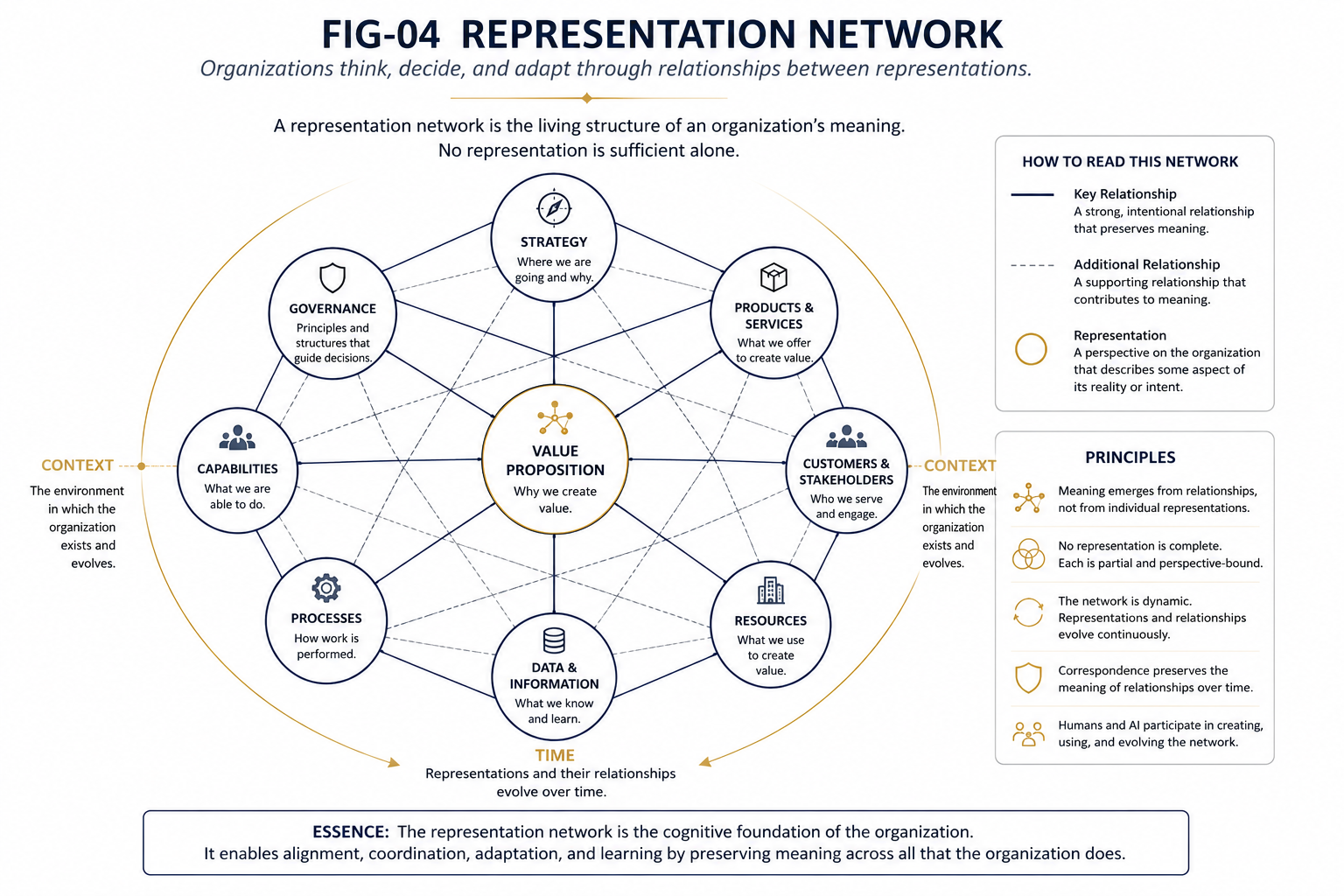
No meaningful representation exists alone. Every strategy points toward a purpose. Every decision points toward a strategy. Every action points toward a decision. Every outcome points toward an action. Every lesson points toward the future. Representations constantly refer to one another. Together they form something far larger than any individual document, policy, or decision. They form the cognitive fabric of the organization. Understanding organizations therefore requires more than studying individual representations. It requires understanding the relationships that connect them. Representations do not create organizational intelligence in isolation. They create it together. The next chapter explores those relationships and the structures they form: Representation Networks.