The AI-Native Organization
An organization can use AI everywhere and still remain structurally pre-AI. It can deploy assistants, automate tasks, and connect models to workflows while preserving the same assumptions about decision rights, coordination, learning, and accountability. That is not an AI-native organization. It is an older organization with more powerful tools. The distinction matters because the competitive question is shifting from access to technology toward the ability to organize around it. Tool adoption can easily be mistaken for organizational redesign.
An AI-native organization makes the deeper move: it integrates intent, people, intelligent systems, governance, execution, and learning into one adaptive operating model. Artificial intelligence does not simply introduce a new technology. It introduces a new organizational possibility.
For years, organizations have treated artificial intelligence as another capability to be integrated into existing structures: a better chatbot, a faster recommendation engine, a smarter analytics platform, or a more capable assistant. These improvements matter, but they do not fundamentally change the organization. An AI-native organization begins somewhere else. It is designed around the capabilities and constraints of intelligent systems from the very beginning. Artificial intelligence is not an add-on. It becomes part of the operating model. The result is not an organization that merely uses AI. It is an organization that operates differently. Intent flows continuously.
Information is continuously available, execution adapts continuously, and learning happens continuously. Leadership focuses on direction rather than supervision. Governance becomes adaptive rather than procedural.
The organization behaves less like a hierarchy and more like a living system. This is what makes an organization AI-native. The difference is architectural, not merely technological. Some public research now points in this direction without yet proving the full model. Microsoft's Work Trend Index describes emerging "Frontier Firms" that combine machine intelligence with human judgment and organize around human-agent teams. McKinsey's survey work similarly suggests that adoption is spreading while value capture depends on organizational rewiring. These are early signals, not settled evidence.
They matter because they show that the question has moved from tool adoption toward organizational design. Figure 9.1 presents the Correspondia version of that design question. It does not borrow another organization's vocabulary; it shows the operating loop this book has been building toward.
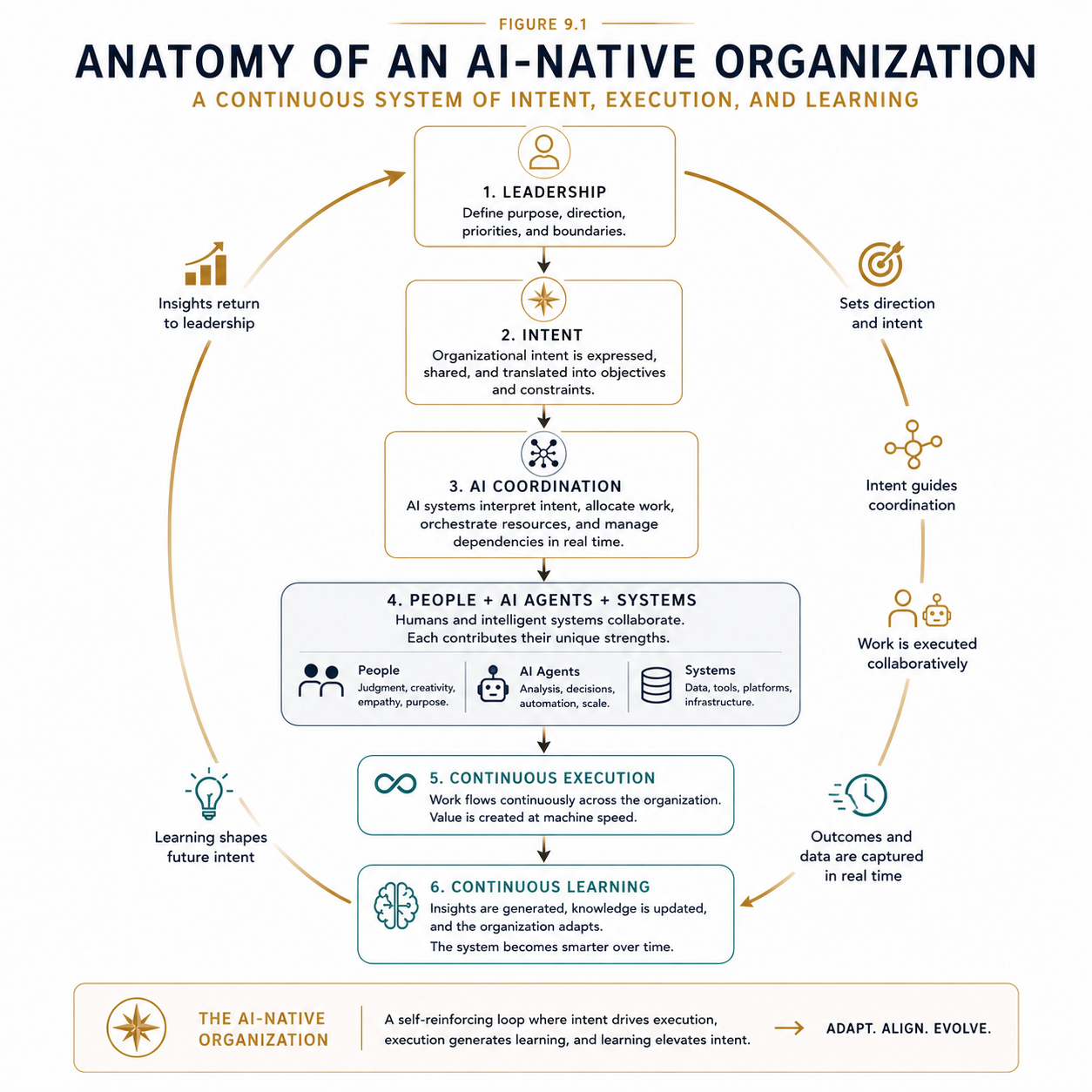
Leadership provides direction, intelligent systems coordinate activity, people contribute uniquely human capabilities, and learning continuously shapes future intent.
The anatomy matters because the parts only create value together. It does not claim that any component replaces the others; it shows executives why AI-native design is an integration problem, not a tool inventory.
This model differs fundamentally from the organizations most leaders know today. Traditional organizations separate planning from execution. Strategy is developed. Plans are created. Projects begin. Execution proceeds. Results are reviewed. Learning informs the next planning cycle. The process is episodic. AI-native organizations compress this entire cycle. Intent guides execution, execution generates information, information becomes learning, and learning refines future intent. The organization no longer waits for quarterly reviews to adapt. Adaptation becomes part of everyday operation. Every organizational component takes on a different role. Leadership defines purpose. Artificial intelligence coordinates execution. People contribute judgment, creativity, empathy, ethics, and imagination. Enterprise systems provide trusted operational capabilities. Together they create a continuously evolving organizational system. No single component fully replaces another.
Each becomes more valuable because the others evolve alongside it. The organization begins to function as an integrated whole. This also changes how work is organized. Instead of optimizing departments, organizations optimize outcomes. Instead of coordinating tasks, they coordinate intent. Instead of improving isolated processes, they improve the behavior of the entire system. The objective shifts from efficiency alone to organizational adaptability. That distinction matters. Efficiency improves existing systems. Adaptability enables entirely new possibilities. In environments where technology, markets, and customer expectations evolve continuously, adaptability becomes the more valuable capability.
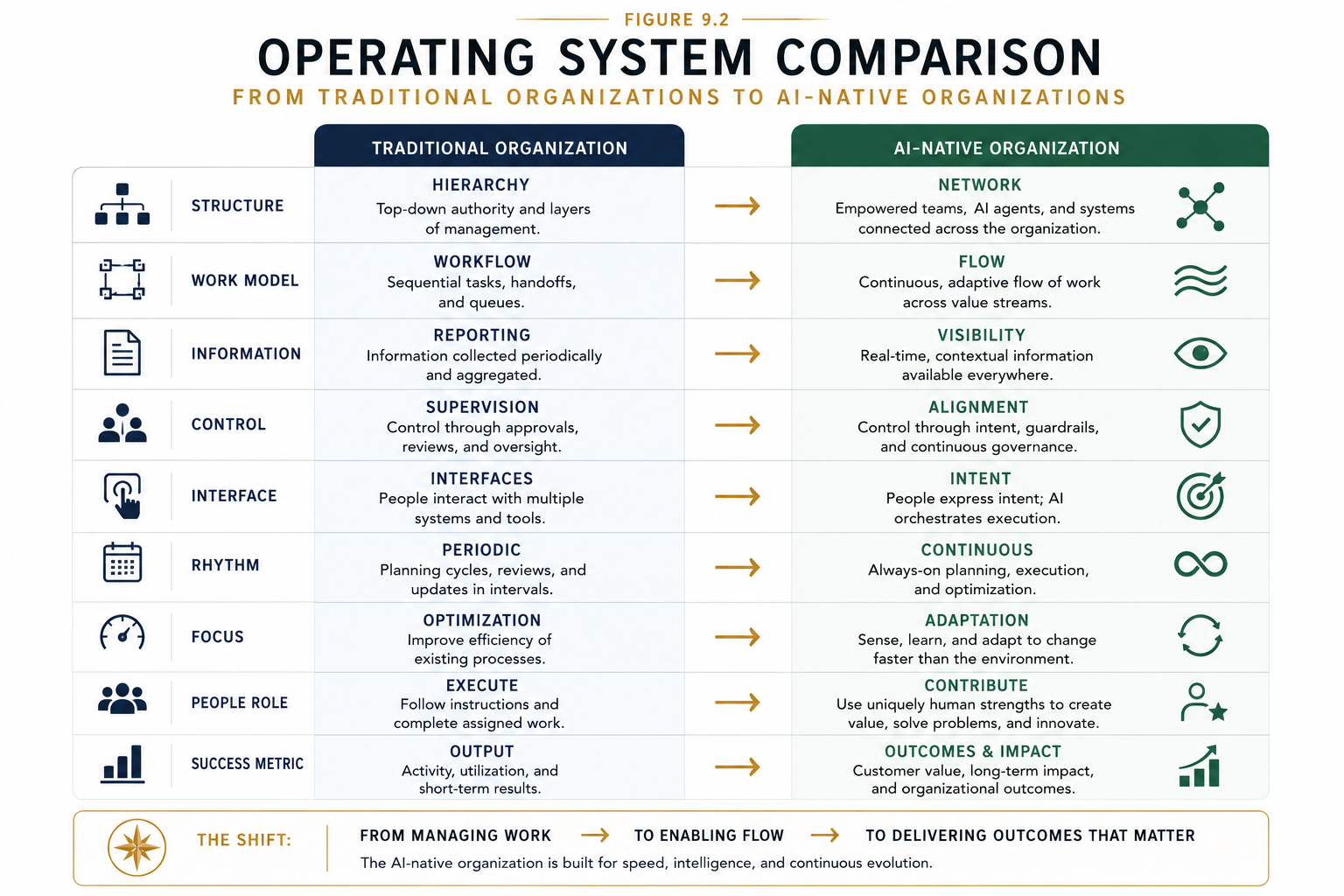
It is defined by replacing the assumptions of the traditional operating system with a fundamentally different organizational model.
The comparison figure clarifies the operating-system distinction. The issue is not whether AI is present, but whether organizational design has changed around it.
Several operating principles characterize these organizations. Intent replaces detailed instruction as people define outcomes rather than prescribing every step. Flow replaces workflow as execution moves continuously toward value instead of progressing through predefined sequences. Visibility replaces periodic reporting as information becomes continuously available. Alignment replaces supervision as control emerges through shared intent, transparency, and adaptive governance rather than constant intervention. Adaptation replaces optimization as organizations continuously learn and evolve rather than repeatedly improving yesterday's processes. Learning becomes embedded in execution rather than separated into management cycles. These principles reinforce one another.
Each chapter of this book has explored one aspect of this transformation. Together they form a different organizational operating system. This transformation is not about replacing people. Quite the opposite.
Artificial intelligence increasingly assumes repetitive coordination, analysis, and execution. Human contribution becomes more valuable where uniquely human capabilities matter most: purpose, judgment, creativity, ethics, empathy, leadership, and innovation. These are not residual responsibilities. They become the defining characteristics of successful organizations. Artificial intelligence expands organizational capability. Human beings determine its direction. That is why AI-native organizations remain deeply human organizations. Technology amplifies people. It does not replace purpose. The organizations that define the coming decades will therefore not simply possess more advanced technology. They will possess better organizational architecture.
They will align people, intelligent systems, data, governance, and leadership into a continuously adapting whole. This is the operating system shift. It is not another digital transformation initiative, another productivity program, or another software implementation. It is the redesign of the organization itself. The organizations that embrace this shift will not merely work faster. They will think, coordinate, learn, and lead differently. They will operate according to principles that were impossible when human limitations defined organizational design. Artificial intelligence changes those limitations, and the operating system must change with them. That is what makes an organization truly AI-native. The AI-native organization is not defined by the presence of intelligent systems. It is defined by the operating model that makes intelligence coherent.
Executive Takeaway
An AI-native organization is designed around the capabilities of intelligent systems: intent guides action, execution flows continuously, learning never stops, and people focus on the uniquely human work of purpose, judgment, creativity, and leadership.