The Control Paradox
The intuitive response to powerful technology is to add control. More review. More approval. More policy. More monitoring. In a slower organization, that instinct often made sense. In an AI-enabled organization, the same instinct can create the opposite result. Control added after execution becomes too late, too slow, or too detached from the evidence needed to govern well. The instinct to add approval, supervision, and policy is understandable. It also misses the larger shift: control must become adaptive, transparent, evidence-aware, and designed into the operating system. Control has always been one of management's primary responsibilities.
Organizations establish policies, approvals, reporting structures, compliance procedures, audits, reviews, and escalation paths. Each mechanism exists for the same reason.
The purpose is to ensure that the organization behaves as intended. For decades, this approach worked remarkably well. Information moved slowly. Work progressed sequentially. Managers had limited visibility into daily execution. Periodic oversight compensated for that limitation. Control depended on supervision. The operating system reflected the realities of human coordination. Artificial intelligence changes those realities. Information becomes continuously available, execution becomes increasingly autonomous, decisions occur more rapidly, and learning happens continuously. The speed of organizational activity accelerates beyond the capacity of traditional supervisory models. This creates a paradox.
The faster organizations become, the less effective direct intervention becomes. Every approval introduces delay, every manual review interrupts flow, and every additional checkpoint reduces the very responsiveness organizations seek to achieve. The instinctive response is to add more control.
The consequence is often less real control. Public governance frameworks now reflect the same pressure. NIST's AI Risk Management Framework is designed to help organizations manage risks across AI system design, development, deployment, and use. The OECD's work on AI incidents and hazards similarly emphasizes accountability, evidence, monitoring, and interoperable reporting. These sources do not tell leaders to abandon control. They point toward a different kind of control: continuous, evidence-aware, and designed into the system rather than appended after the fact. That distinction is what Figure 8.1 makes visible.
In a slow organization, control can look like review. In a fast organization, control must increasingly look like alignment.
Figure 8.1 shows the paradox directly: intervention can increase while real controllability decreases.
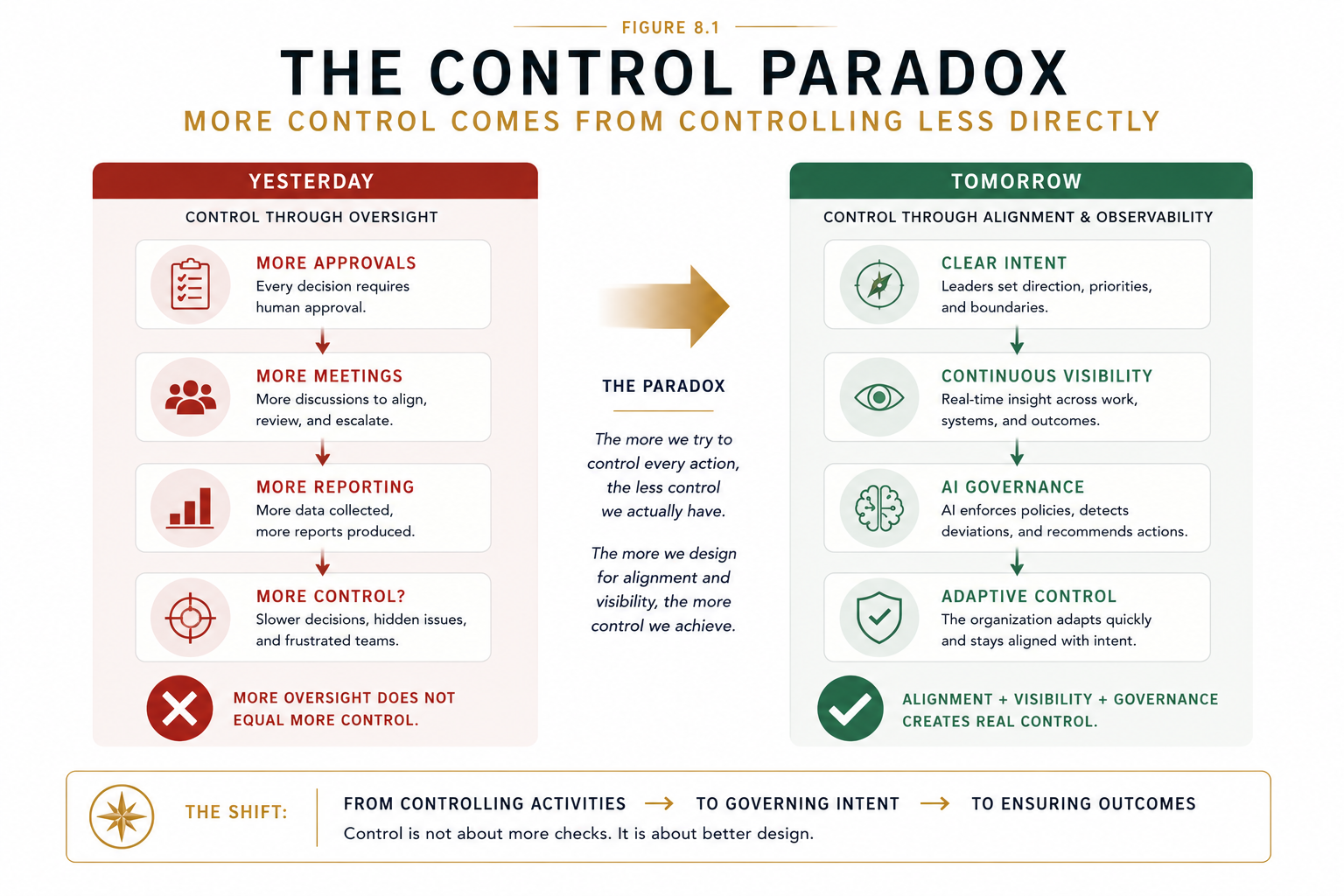
AI-native organizations achieve greater control through clear intent, continuous visibility, and adaptive governance.
The model shows why supervision alone cannot govern adaptive execution. Control has to move closer to intent, evidence, transparency, and operating-system design.
The problem is not governance itself. The problem is how governance is implemented. Traditional organizations often equate control with supervision. If leaders review more work, more control exists. If approvals increase, risk decreases. If reporting expands, visibility improves. These assumptions were reasonable in environments where information arrived slowly and uncertainty remained high. Artificial intelligence changes the relationship between information and action. Visibility no longer depends on reports. Execution no longer depends on constant supervision. Organizations can observe what is happening as it happens. Governance shifts from reviewing completed work to continuously observing organizational behavior.
Control becomes proactive rather than reactive. The objective is no longer to inspect every decision. It is to ensure that decisions remain aligned with organizational intent.
This is a fundamentally different definition of control. Control is not the ability to intervene in every activity. It is the ability to ensure that the organization consistently behaves in accordance with its purpose, priorities, constraints, and values. That distinction becomes increasingly important as execution accelerates. The faster intelligent systems operate, the less practical continuous human intervention becomes. Organizations cannot approve every decision made every second. Nor should they. Instead, leaders define intent. Establish boundaries. Specify policies. Determine acceptable risk. Artificial intelligence continuously operates within those guardrails.
When execution remains inside those boundaries, intervention becomes unnecessary. When behavior begins to diverge, governance responds immediately. Control becomes adaptive rather than procedural.
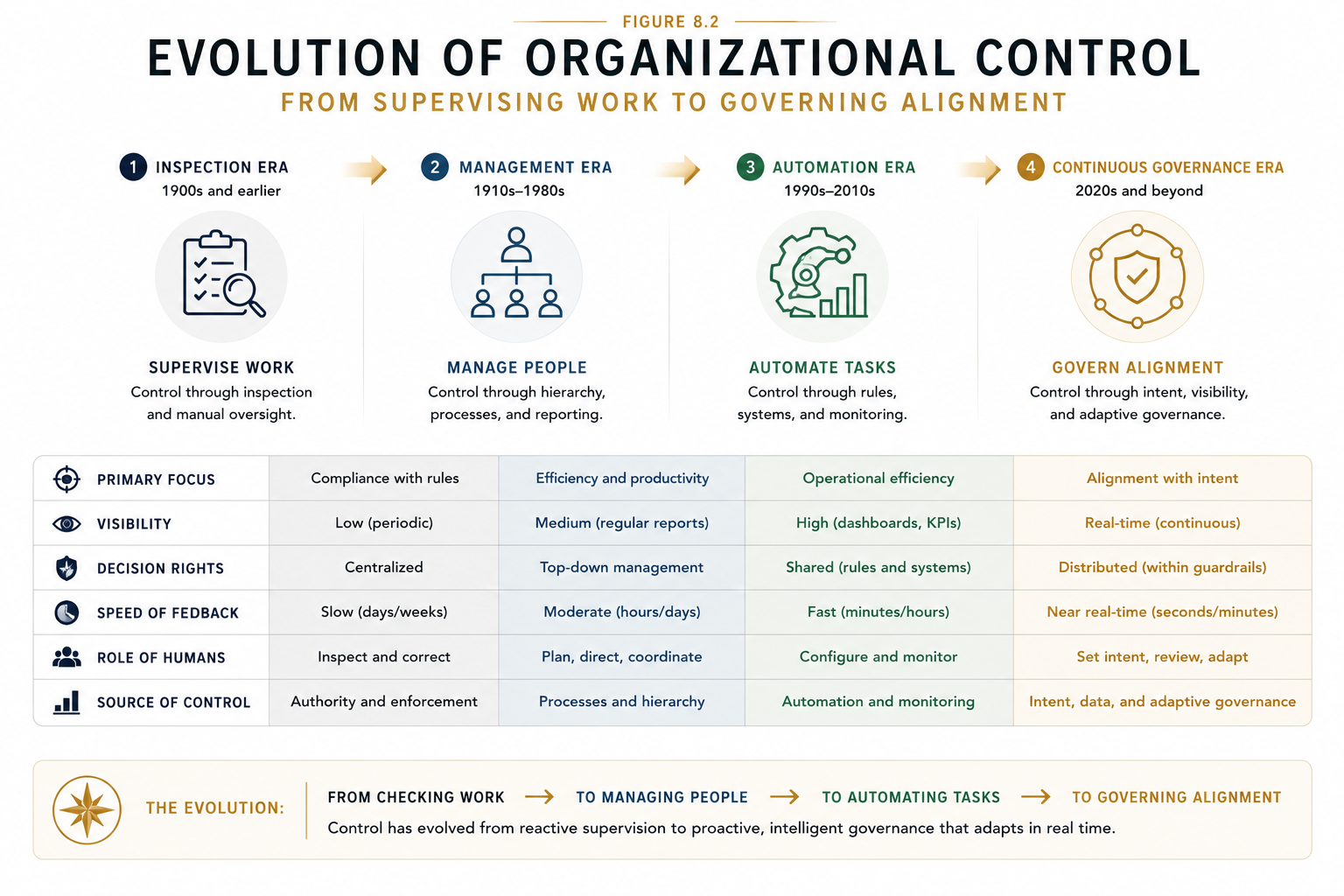
As AI-native organizations emerge, alignment with intent becomes the primary source of control.
The control-evolution figure adds the time dimension. Governance matures when it moves from delayed inspection toward continuous alignment.
This represents one of the largest changes in management philosophy. Historically, organizations inspected work after it occurred. Later, they managed people performing the work. Then they automated repetitive activities. The next stage governs alignment itself. Rather than asking, "Who approved this?" organizations increasingly ask, "Did this remain aligned with our intent?" The emphasis shifts from activity to behavior, from supervision to observability, and from intervention to adaptation. This does not reduce accountability. It strengthens it. Continuous visibility creates a far more complete understanding of organizational behavior than periodic reporting ever could.
Leaders gain better information, earlier warning signals, faster learning, and more informed decisions. The result is greater confidence with fewer interruptions. Trust changes as well. Traditional organizations often assumed trust required verification through repeated oversight.
AI-native organizations increasingly create trust through transparency. When organizational behavior is continuously visible, fewer manual checks are required. Confidence comes from observability rather than bureaucracy. The organizations that succeed will therefore not eliminate governance. They will redesign it. Governance becomes embedded, continuous, adaptive, always present, and rarely intrusive. This is the control paradox. The organizations with the greatest control are not those that intervene the most. They are those that have designed systems requiring the fewest interventions. Because alignment exists by design rather than by constant supervision.
Artificial intelligence does not reduce the need for governance. It changes where governance operates: less within individual activities and more within the operating system itself. The future of management will therefore not be defined by larger approval chains, more reporting, or more oversight. It will be defined by better organizational design. Leaders will increasingly govern intent. Intelligent systems will continuously govern execution. Together they create organizations that are simultaneously more adaptive, more transparent, and more controllable than any previous operating model. That is the operating system shift. Control is no longer achieved by slowing work down. It is achieved by ensuring that work remains aligned while moving at unprecedented speed.
The paradox resolves only when control stops being an interruption and becomes part of how the organization continuously aligns intent, action, and learning.
Executive Takeaway
Control is no longer created by supervising work. It is created by designing organizations where intent, transparency, and adaptive governance keep execution continuously aligned. The highest-performing AI-native organizations will not require more interventions; they will require fewer because their operating systems are designed for alignment from the start.